Valuing SEP portfolios through evidence
O’zapft is! Take the Munich test: can you spot the difference between the two skylines below? Now for the harder question: which one is wrong? If you are in Munich for the Wiesn, try a little investigation between visits.
Call it “architectural beer goggles”: suddenly, every church tower looks equally tall. In the upper image, I have deliberately given each tower the same height. It makes the skyline tidy, but hides the differences.
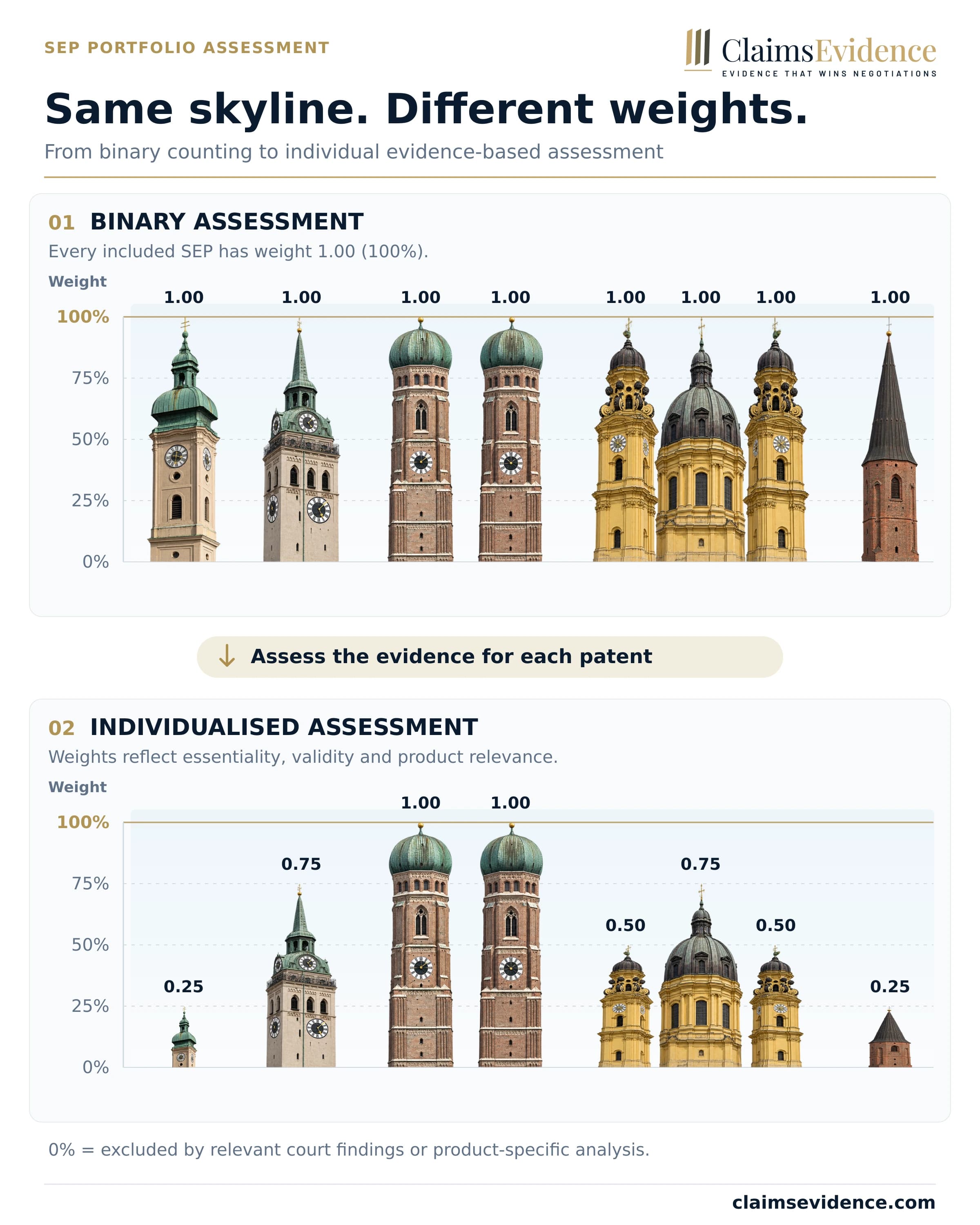
Both images are deliberately modified. The lower skyline is not a reconstruction of Munich’s actual building heights: it illustrates weights of 0.25, 0.50, 0.75 and 1.00. The two Frauenkirche towers retain their full height. Closer scrutiny can confirm strength as well as reveal weakness.
The same question arises when patent counts feed into SEP portfolio valuation. Giving every included patent one unit can conceal substantial differences in the evidence supporting product relevance, essentiality and validity. I think we should explore individual evidence weights that make those differences visible and usable in licensing discussions. This article sets out that proposal and considers how independent AI assessments, combined with expert review, could help apply it consistently.
What connects this Munich skyline to Munich’s new FRAND Guidelines? The connection is the role that portfolio shares can play in assessing royalties, and the evidence used to establish those shares.
Judge Oliver Schön’s new FRAND Guidelines have brought the relationship between comparable licences and top-down analysis into focus. Public accounts of the Munich I Regional Court’s 7th Civil Chamber Guidelines, dated 13 August 2026, describe comparable licences as the starting point. Top-down analysis generally provides a cross-check and may become the primary approach where suitable comparables are unavailable. The Guidelines express the Chamber’s position, rather than a rule binding other courts. [1]
At the Munich IP Forum on 22 September, I understood Schön’s explanation to give top-down analysis a particularly influential role: helping identify the relevant range within which suitable comparable licences should be considered. If that range helps determine which agreements qualify as comparables, top-down analysis can shape the selection of the evidence itself. That is my understanding of his conference remarks, rather than a quotation from the Guidelines. [2]
That emphasis is consistent with public commentary reporting that a material excess over the top-down result calls for closer scrutiny of the comparables, although a lower top-down figure does not automatically displace an established comparable licensing practice. [7]
Comparable-licence analysis draws on negotiated royalties under sufficiently similar agreements. Top-down analysis starts with an aggregate royalty burden for the standard and allocates a share to the portfolio. Wherever patent counts inform either calculation, the skyline question becomes a valuation question: what should each patent contribute to that share?
The limits of binary counting
In a simple counting model, each declared SEP in the portfolio contributes one unit. A patent excluded following a finding of non-essentiality or invalidity contributes zero. Everything between those endpoints disappears: a patent facing a substantial prior-art attack may carry the same weight as one with a much stronger evidentiary position.
This is a simplified baseline, not a claim that Schön or all courts disregard portfolio quality. The question is whether we can make the contribution of each patent more explicit and consistently evidence-based wherever patent counts are used.
Figure 1 illustrates 18 declared patents. Two are crossed out following adverse court findings and contribute zero, leaving 16 units. For this schematic, those findings are assumed to dispose of the relevant claims within the scope being assessed. A real assessment must respect the judgment’s scope and any appeal or surviving claims.
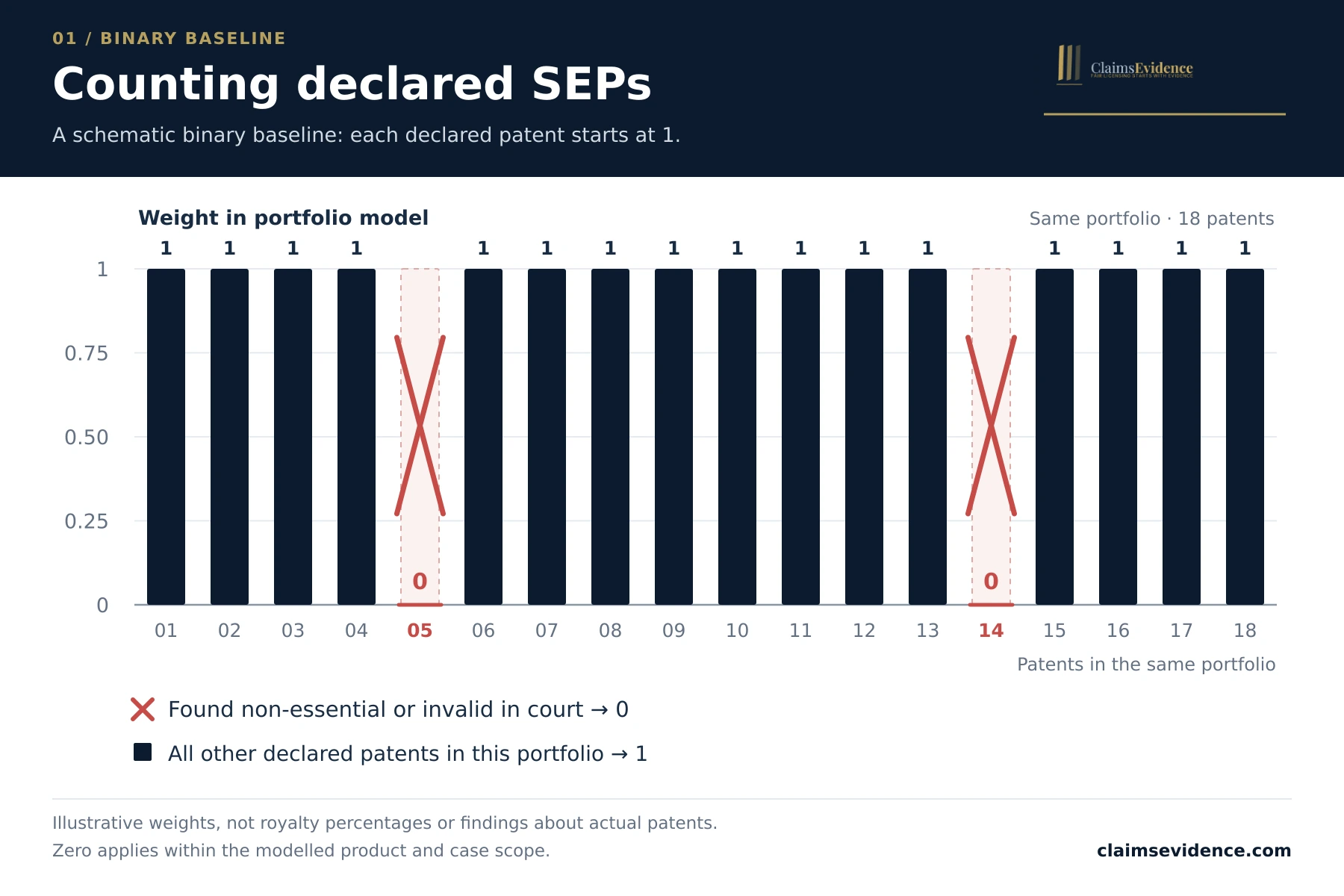
Other rights of the same owner, or SEPs held by another owner or pool, contribute zero to this particular portfolio’s count. That does not make them worthless. Another owner’s SEPs may still belong in the total standard stack used as the denominator. A non-SEP may have separate licensing value.
A proposed weight for each patent
Figure 2 keeps the same 18 patents and the same two court exclusions. Three further patents receive zero because their required standard features are not implemented in the products under assessment. The remaining patents receive illustrative weights of 0.25, 0.50 or 0.75, reflecting different levels of evidentiary strength.
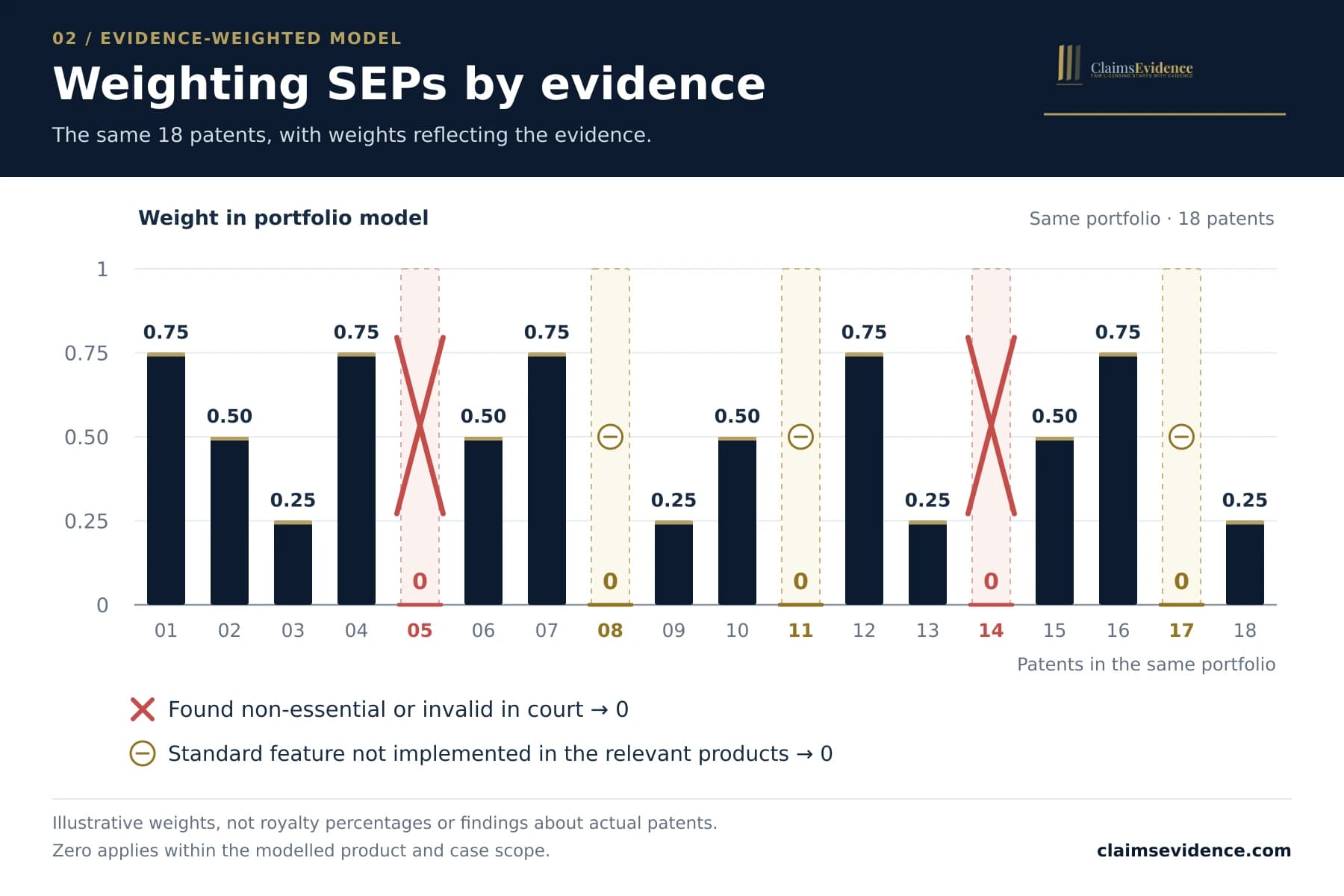
The proposal is to replace the raw count with the sum of individual evidence weights. A weight of 0.50 means half a unit in this assessment model. It is not, without separate calibration, a 50% probability of winning in court or a valuation of the invention’s economic contribution. A fully supported patent could retain a weight of 1, although the chart in Figure 2 deliberately uses only the intermediate bands for the surviving patents.
How evidence could determine the weight
Three types of analysis provide a practical starting point. They correspond to work we undertake at ClaimsEvidence, including product-specific portfolio filtering, counter-claim charts and prior-art analysis. [4–6]
Features absent from the licensee’s products
Start with the products covered by the proposed licence. Which functions do they actually implement? For cellular products, this can involve mapping the device and radio module to the relevant standard release, capabilities and configuration, then checking what the patent claims require. Our 4G Landscaping Filter follows this product-specific logic. [4]
A patent requiring a function that the relevant products do not implement can receive zero for that product scope, provided no other relevant claim supplies a basis for inclusion. Merely finding that a standard feature is optional is insufficient: the evidence must establish its absence from the products. Where implementation remains uncertain, the result should remain unresolved rather than automatically become zero.
Evidence challenging essentiality
The next question is whether implementing the standardised functionality at issue necessarily satisfies every limitation of a relevant claim. A counter-claim chart can expose a missing requirement, a mismatch between the claimed actors and the implementation, or a mapping that combines passages without establishing that they operate together. [5]
Such evidence can materially weaken the essentiality case without resolving it conclusively. The parties may disagree on claim construction or the significance of the standard text. An intermediate weight can recognise that weakness while preserving the remaining uncertainty. It avoids treating every patent without an adverse judgment as equally well supported.
Evidence challenging validity
Prior art can likewise weaken a patent before any court or patent office revokes it. The analysis should identify the operative claim, the relevant date and what the earlier disclosure establishes. A potentially decisive novelty attack deserves different treatment from a speculative inventive-step objection. ClaimsEvidence’s prior-art and validity work provides this type of claim-level evidence. [6]
The identified attack may nevertheless fail, or a narrower claim may survive and remain relevant. An intermediate weight can reflect that uncertainty. Essentiality and validity should also use a consistent claim construction. Related weaknesses should feed a documented overall assessment, without counting the same weakness twice.
Making the assessment more repeatable
Assigning a precise value such as 63.7% would suggest a degree of accuracy that is difficult to justify. Two practical choices could make the proposal more workable.
First, use a small set of bands. Keep the endpoints of 0 and 1, with intermediate weights of 0.25, 0.50 and 0.75. The parties would agree what evidence distinguishes the bands before scoring the portfolio. Substantial unresolved objections might support 0.25, mixed evidence 0.50, and a stronger case with limited unresolved concerns 0.75. These are proposed assessment categories to test and calibrate, rather than established probabilities. Each assignment should identify the sources and reasoning that justify it.
Second, require substantial agreement between at least two different AI systems. Ideally, each opposing party would nominate one system. Both would assess the same defined patent and product scope using a common scoring rubric, with access to the evidence relied on by either side. They would provide their source-linked reasoning independently before their results were compared.
Agreement should be assessed patent by patent, since similar portfolio totals can conceal large individual disagreements. The parties should define the required agreement in advance and send material differences for expert review. Two systems can share the same error, so agreement is a reproducibility check rather than proof of correctness. Repeated runs, tests against reviewed examples and human assessment of disputed conclusions would help establish whether the method is dependable.
Applying the weights to a FRAND analysis
A weighted portfolio could inform adjustments between comparable portfolios and the portfolio share used in a top-down calculation. For the latter, the relevant share would be the portfolio’s weighted units divided by the weighted units of the relevant standard stack.
Both sides of that fraction need a consistent basis. Applying detailed discounts to one portfolio while leaving the entire denominator as an untested declaration count would distort the comparison. Consistency between the portfolio and reference population is also an express requirement in public accounts of the Munich Guidelines. [7] The counting unit, treatment of patent families, product scope, territories and time period must align. Reference portfolios used for comparable-licence analysis need a compatible assessment too. If a full assessment is impractical, any sampling and extrapolation should be explicit.
These weights would supply one input to valuation. They would not themselves establish the aggregate royalty burden or account for every commercial difference between licences. Nor does the change from 16 to 6.75 units in the drawings imply the same proportional change in a FRAND rate.
A fairer basis for discussion
This will be difficult to calibrate, and reasonable people will disagree about individual bands. Even so, I believe a transparent assessment grounded in evidence is likely to be fairer than giving every patent full weight solely because its owner declared essentiality that has never been independently checked. ETSI itself explains that it does not verify the essentiality of the notified rights. [3]
The practical question is whether we can agree a sufficiently reliable method for those differences in evidence to influence the negotiation. I would welcome views from both licensors and implementers on what would make such a method credible.
Sources
[1] Boehmert & Boehmert, New FRAND Guidelines of the 7th Civil Chamber of the Munich I Regional Court, 28 August 2026, especially “Determining the Range: Comparable Licenses First”. This is a public summary of the Guidelines.
[2] Munich IP Forum 2026 agenda, 22 September, 14:00 panel on FRAND rate determination. The agenda confirms Schön’s participation. The account of his remarks above is the author’s recollection, not a published transcript.
[3] ETSI, SR 000 314 V2.39.1, March 2026, Foreword at p. 4 and Section 4.0 at p. 10.
[4] ClaimsEvidence, Product-Specific LTE SEP Landscaping, and FRAND FIRST Meets AI, Section 5 on the 4G Landscaping Filter.
[5] ClaimsEvidence, Counter-Claim Charts, 12 August 2026, updated 14 August 2026.
[6] ClaimsEvidence, From Claim Chart to Counter-Argument, and claim-level analysis services.
[7] Grünecker, Munich District Court Publishes Comprehensive FRAND Guidelines for SEP Litigation, 31 August 2026, Sections III.2.1 and III.2.2. This is a public summary of the Guidelines.
Get our practice notes and deep-dive reports first
We publish deep technical analyses on SEP essentiality, FRAND evidence, and patent-licensing risk — with purpose. Subscribe to get each one when it lands.
No spam. Unsubscribe any time.
About the author

Christoph Hewel
ClaimsEvidence Co-Founder & CPO · Patent Attorney & UPC Representative
Christoph Hewel is a patent attorney and UPC representative with extensive experience in SEP litigation. He is Co-Founder / CPO of ClaimsEvidence and has represented clients in major patent cases, including Huawei v. Unwired Planet, Microsoft v. SIA, and Wiko / Google / Asus / HTC v. Philips, among others.
View LinkedIn profile