Not Every 4G SEP Is Relevant: How Product-Specific LTE Landscaping Creates Early Non-Essentiality Arguments
Product-specific SEP landscaping is a structured method for mapping asserted standard-essential patents (SEPs) onto the actual implementation scope of an accused product, rather than treating all declared patents as presumptively relevant. In SEP licensing disputes involving standards like 4G LTE — where approximately 38,000 patent families have been declared to the ETSI IPR database — this approach enables implementers to identify early non-essentiality arguments by distinguishing patents that target core baseline features from those directed at optional, architecture-dependent, or later-release technology branches. The method is particularly valuable for IoT devices, payment terminals, industrial modules, and other product categories that implement only a subset of a complex cellular standard.
Why not all 4G LTE SEPs are relevant to every product
When an implementer receives a licensing demand for a portfolio declared against 4G LTE, the initial impression is often deceptively simple: the products use LTE, so at least some of the asserted patents must be relevant.
That assumption is understandable. It is also frequently too broad.
From a legal and technical perspective, "4G LTE" is not one monolithic feature. It is a broad standards ecosystem spanning multiple releases [3GPP releases], protocol layers, services, architecture concepts, and optional enhancement paths. A patent may well map to an LTE feature in theory, and yet still fall outside the actual implementation scope of the accused products.
This is where product-specific SEP landscaping becomes strategically valuable.
At ClaimsEvidence, this is not a purely visual exercise or an abstract AI classification task. It is part of a broader expert-led analysis in which AI, telecommunications engineering, patent law, and litigation judgment are deliberately brought together. Our aim is not merely to identify declared SEPs. Our aim is to determine which patents are likely to matter for the client's actual products, which patents require deeper review, and which patents are strong candidates for early non-essentiality arguments.
This article illustrates that approach through an anonymized internal exercise involving a vendor of 4G-enabled payment terminals. We use that example to show how a product-specific LTE landscape can function as an early disqualifier gate for SEP analysis.
The analysis can be understood in three steps, reflected in the three diagrams below.
How Product-Specific SEP Landscaping Works
Step 1: Build the neutral technology map
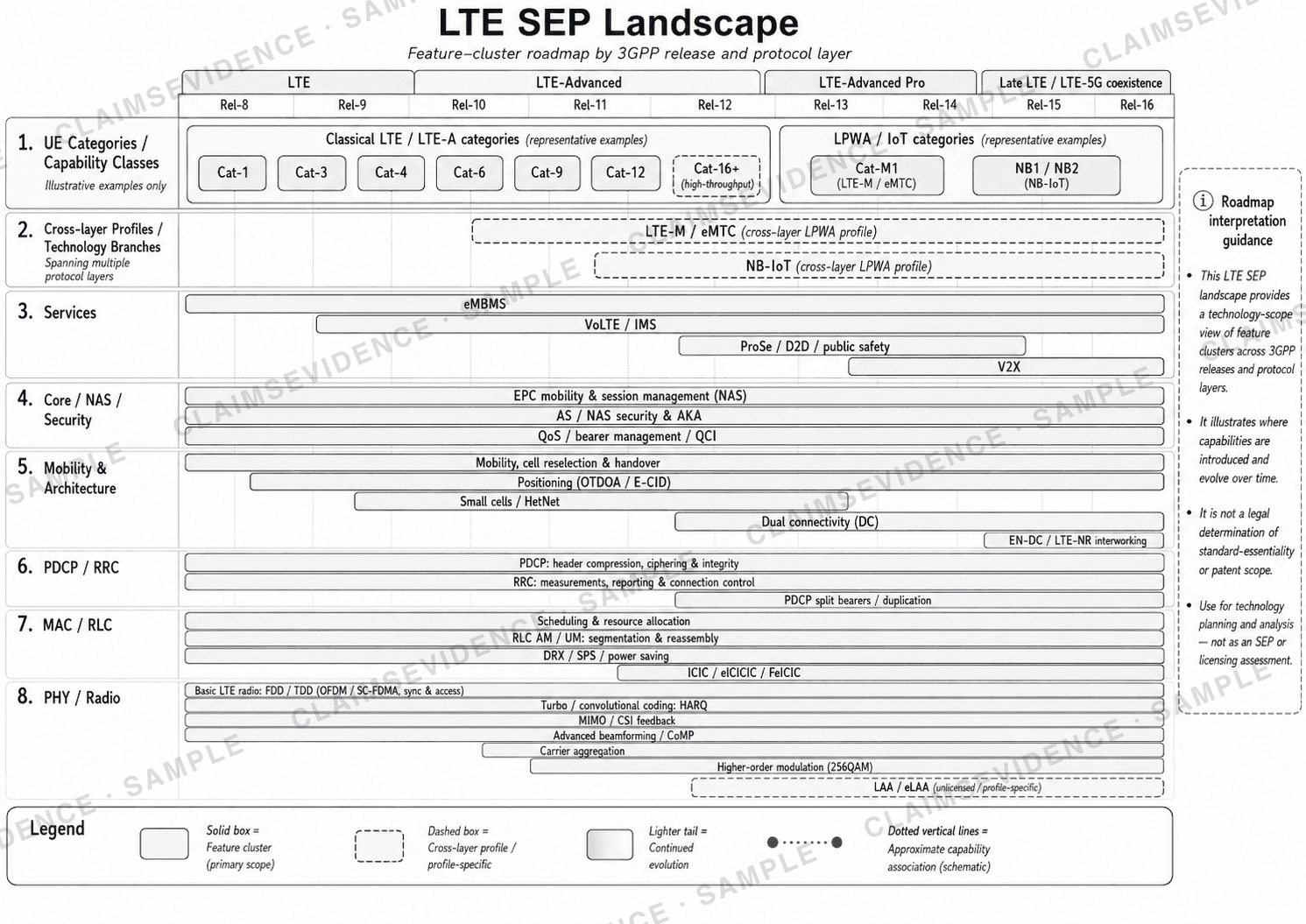
The first step is to construct a neutral technology landscape. This is not yet about the client. It is about the standard.
The purpose of the first diagram is to provide a structured roadmap of LTE feature clusters across:
- 3GPP releases,
- protocol layers,
- services and architecture topics, and
- cross-layer technology branches.
In other words, it provides the technical map before any product-specific overlay is applied.
This is important because SEP analysis often goes wrong at the very beginning. A declared patent is too easily treated as "an LTE patent," without asking the more precise question: which part of LTE?
A patent directed to basic bearer management, NAS procedures, or ordinary RRC control sits in a very different technical and legal position from a patent directed to dual connectivity, small-cell architecture, broadcast services, ProSe, or later-release coexistence mechanisms. All of these may be "within LTE" at some level of abstraction, but they do not carry the same product relevance, nor the same essentiality logic.
That is why ClaimsEvidence's first step is to create a release and layer-aware map of the LTE territory.
Why a neutral landscape map has legal relevance
From a legal perspective, this first step already does more than organize the technology. It frames the essentiality question correctly.
In SEP disputes, the decisive question is not whether a patent can be associated with the standard at a very high level. The relevant question is whether a standards-compliant implementation of the relevant product type would, in practice, have to implement the claimed feature, or whether the patent instead maps to an optional, specialized, or architecture-dependent branch.
A neutral landscape helps expose that distinction.
It also prevents the common analytical mistake of treating all LTE patents as if they sat equally close to baseline conformance. In reality, some sit near the core. Others sit near the edge. That distinction often becomes decisive later when assessing essentiality, infringement risk, non-use, and the credibility of a product-specific defense.
Step 2: Overlaying the product implementation scope
Once the neutral LTE landscape exists, the second step is to overlay it with a product-specific heatmap.
This is the point at which the analysis shifts from What exists in LTE? to What is likely to matter for this product category?
In the example shown here, the products are 4G-enabled payment terminals. That is already a highly informative technical fact. These are not smartphones, tablets, media devices, or data-heavy consumer terminals. Their typical design priorities are different:
- reliable connectivity,
- secure transaction transport,
- module-based LTE implementation,
- cost discipline,
- certification stability,
- long product life,
- often modest bandwidth needs.
This changes the likely implementation profile in a meaningful way.
For an additional first-gate classifier, see our note on LTE category analysis and how UE categories can help position an accused LTE product before patent-cluster review.
The Heatmap Logic: Likely Used, Uncertain, and Likely Not Used
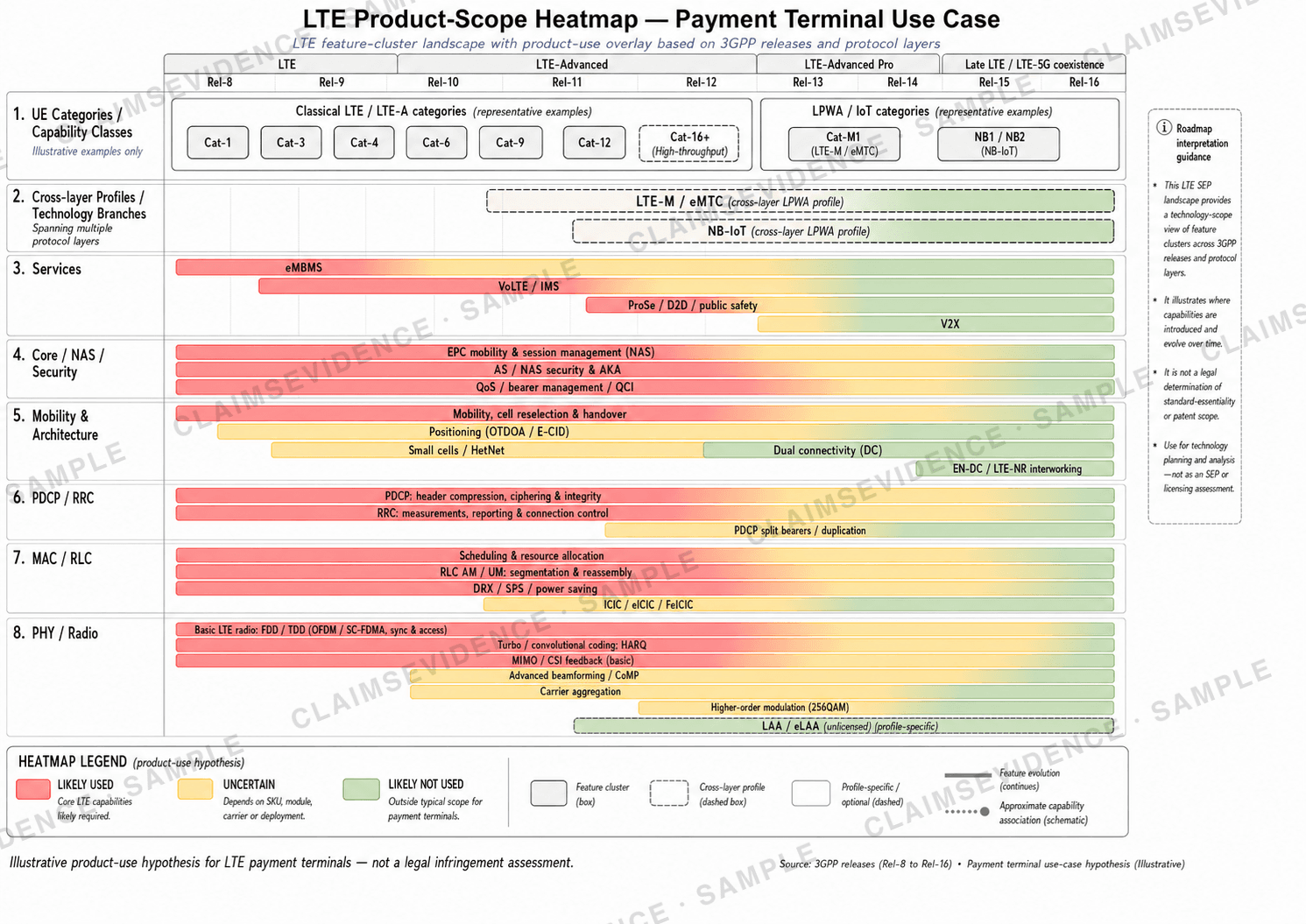
The second diagram classifies LTE feature areas into three broad zones:
1. Likely used
These are feature areas close to the expected technical core of the products.
For payment terminals, that typically includes:
- baseline LTE radio access,
- ordinary bearer management,
- NAS and security procedures,
- conventional RRC / PDCP / MAC / RLC control,
- and at least basic mobility behavior such as cell selection, reselection, and handover-related procedures.
This point deserves emphasis: even if a payment terminal is relatively stationary compared with a smartphone, it does not follow that mobility-related functionality is irrelevant. Basic LTE mobility mechanisms remain part of ordinary network behavior. The real distinction is not between "mobile" and "immobile" in a colloquial sense. It is between ordinary LTE mobility and specialized architecture enhancements.
2. Uncertain
These are feature areas that may depend on:
- the precise module variant,
- the concrete SKU,
- network deployment conditions,
- carrier configuration,
- or whether the feature is present at modem level but not central to the product's commercial use case.
Examples may include some PHY-layer enhancements, CSI feedback behavior, or more advanced radio optimization features.
3. Likely not used
These are feature areas that, while part of LTE broadly understood, are likely outside the realistic implementation scope of the payment-terminal use case.
This is particularly important for advanced architecture branches such as dual connectivity, which in the revised heatmap is shown as beginning at Release 12 and marked as likely-not-used for this product category.
That placement is not arbitrary. It reflects the core strategic idea of the exercise: some LTE patents map to later-release architecture features that are not part of what one would normally expect in an ordinary payment terminal implementation.
Why Product-Specific Scoping Matters for Essentiality and Infringement
This second step is where ClaimsEvidence's combined technical and legal expertise becomes especially important.
A purely technical team might only say a feature is unlikely to be used. A purely legal team might only say the patent is "not obviously essential." But in SEP disputes, the stronger point is often the intersection:
- Is the feature optional within the standard?
- Is it implementation-dependent?
- Does it depend on specific architecture assumptions?
- Is it merely supported by a chipset family in theory, or actually relevant to the accused product?
- Would the patent owner need to rely on a feature path that sits outside the implementer's realistic product scope?
These are not merely engineering questions. They are legally significant because they shape the essentiality and infringement analysis.
A patent can be declared to LTE and still be weak against a particular implementer if the patentee's theory depends on a part of LTE that the product does not use, or is unlikely to use. That is the essence of a product-specific non-essentiality argument.
Step 3: Placing asserted patents into the landscape
The third step is where the landscape becomes operational.
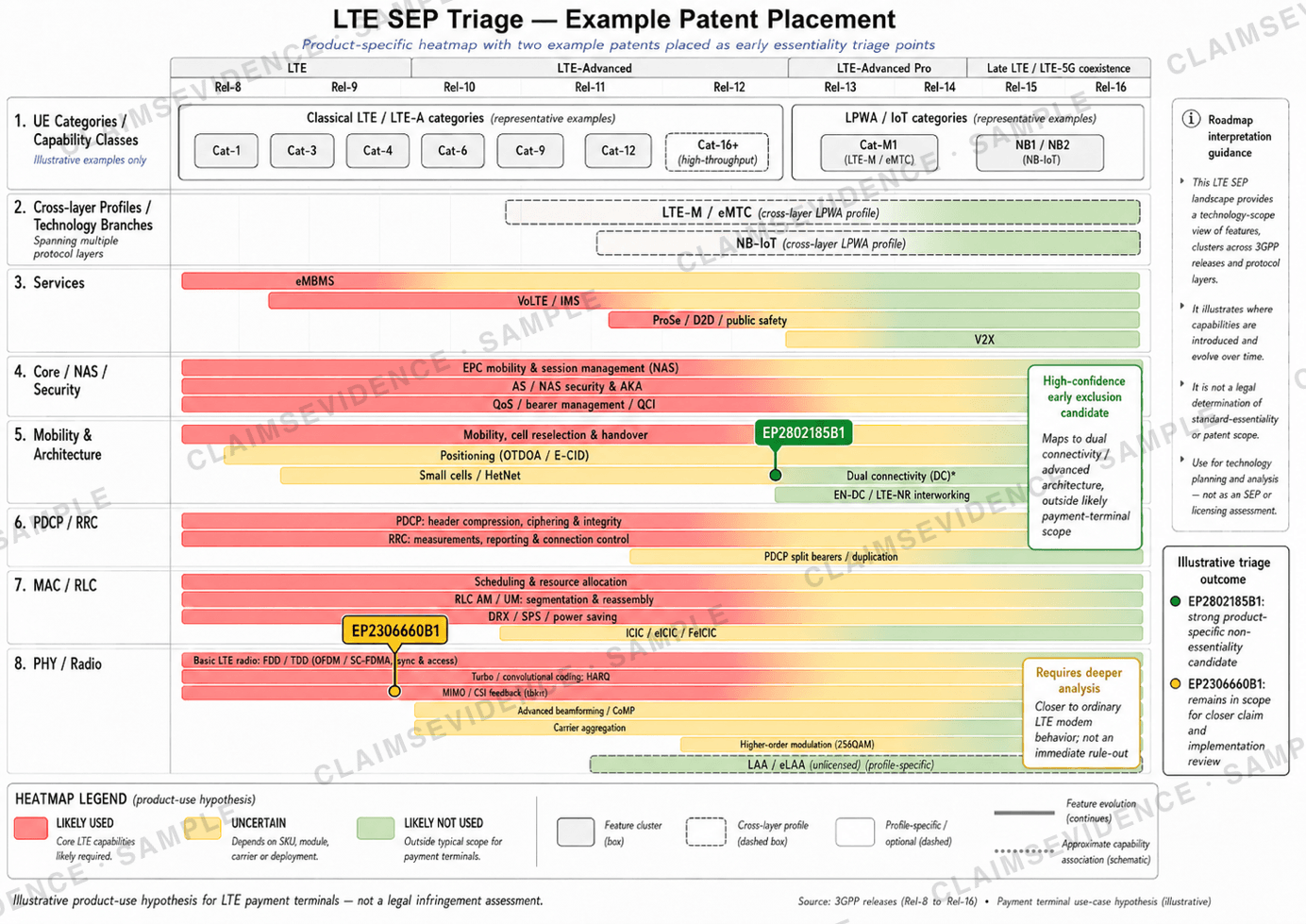
Once we have both the neutral LTE map and the product-specific heatmap, we can place individual patents into that framework. This allows us to test whether a patent should be:
- treated as potentially central and reviewed in depth,
- treated as uncertain and escalated for claim-level analysis,
- or treated as a strong candidate for early exclusion.
In the present example, we placed two patents into the map:
The contrast between the two is instructive.
Case Study: Two Patents, Two Different Outcomes
Example 1 — EP2802185B1: A strong early non-essentiality candidate
In our placement exercise, EP2802185B1 maps into the dual connectivity / advanced mobility architecture area.
That is relevant for two reasons.
First, from a technical standpoint, the patent sits in a region that is not close to the most probable implementation scope of a payment terminal. In the revised diagram, dual connectivity is shown as beginning at Rel-12, and the patent marker is placed at the very beginning of that Rel-12 entry point. That visual placement reinforces the central analytical point: the patent belongs to a later architecture branch rather than to the baseline LTE functionality most likely relevant for the product.
Second, from a legal standpoint, that positioning makes EP2802185B1 a strong candidate for an early product-specific non-essentiality argument.
The key issue is not whether the patent can somehow be linked to LTE in general. The key issue is whether the asserted independent claims read onto a feature path that is realistically part of the accused product's implementation.
If the patent owner needs to rely on dual connectivity or a similar advanced architecture concept to make its essentiality case, that is no longer a core-baseline SEP theory. It becomes a much more product-specific assertion.
That distinction is highly valuable in negotiations. It allows the implementer to say, in substance: This patent may relate to LTE at a general level, but it appears to sit in a later, specialized architecture branch that is outside our likely product scope.
That is not yet a final non-infringement opinion. But it is far more powerful than treating the patent as presumptively essential simply because the products use 4G.
This is exactly what an early disqualifier gate is supposed to achieve.
Example 2 — EP2306660B1: Why this patent requires deeper claim analysis
EP2306660B1 produces a different result.
In our placement exercise, it sits much closer to the ordinary LTE modem / PHY / feedback behavior area. That does not mean it is essential. It does mean it is too close to ordinary LTE implementation territory to be screened out early on product-category logic alone.
This is a very important type of result.
A good landscaping exercise is not just about excluding patents. It is also about deciding where deeper work is justified.
In the case of EP2306660B1, the conclusion is not "relevant" or "irrelevant" in the abstract. The conclusion is narrower and more disciplined: this patent cannot be ruled out at an early stage merely by pointing to the product category. It remains within scope for closer claim analysis and implementation review.
That is already a valuable outcome. It tells the client where to spend time and where not to spend time.
In practice, this kind of patent will thus move into the next layer of analysis in ClaimsEvidence's pipeline, which includes:
- closer review of the independent claims,
- identification of the relevant standards context,
- modem-level capability review,
- implementation-specific evidence gathering,
- and, if needed, broader legal squeeze analysis involving essentiality, claim construction, and validity.
Why this process is more than an AI visualization exercise
The three figures above may look like diagrams. In reality, they represent a structured legal-technical workflow.
This matters because ClaimsEvidence is not a generic patent-tech platform and not a "dashboard" business. Our product-specific landscaping work is part of an expert-led SEP defense process.
AI does not replace legal analysis — it accelerates and structures it
The AI-supported workflow helps us:
- organize the standards space,
- classify feature clusters,
- connect patents to technical areas,
- identify optionality and implementation dependency,
- and surface early disqualifier hypotheses.
But the decisive value lies in what happens next.
ClaimsEvidence has SEP litigators and patent attorneys in-house. That means the outputs are not left at the level of visual intuition or raw technical tagging. They are evaluated through the lens of:
- essentiality doctrine,
- claim scope,
- claim construction discipline,
- optional versus mandatory standard features,
- product-specific non-use,
- evidentiary strategy,
- and the practical needs of FRAND negotiation and potential litigation.
This bridge between engineering and legal analysis is essential.
Conclusion for Implementers Facing SEP Demands
The broader lesson for implementers is simple but important: not every 4G SEP is relevant to every 4G product.
That proposition sounds obvious once stated clearly. Yet in practice it is often neglected, especially in the early phase of SEP licensing negotiations. At that point, declared portfolios, high-level claim charts, and broad references to "LTE" can create artificial pressure before the implementer has tested whether the asserted patents are actually relevant to its products.
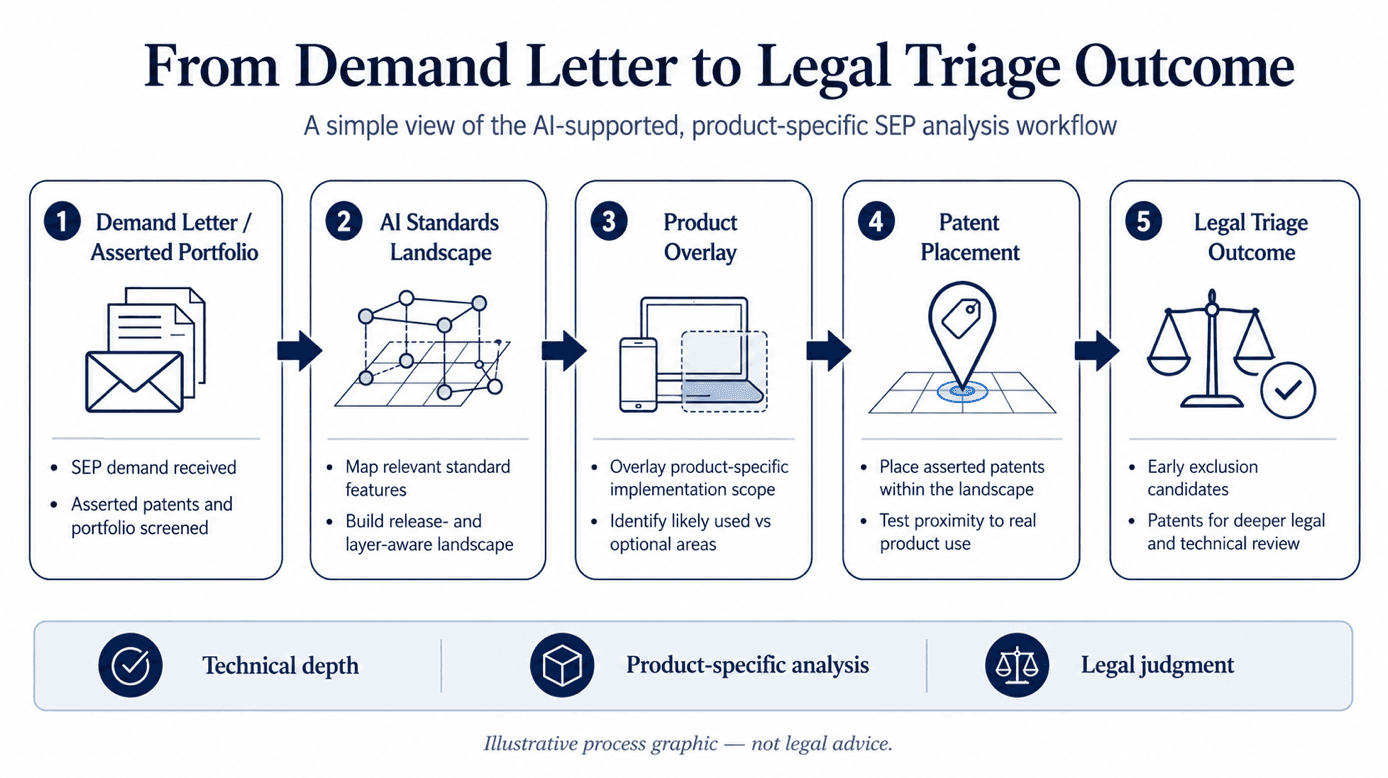
This is why product-specific SEP landscaping should not start with the patent owner's declaration list alone. It should follow a structured workflow:
This is particularly important for IoT products, industrial devices, payment terminals, modules, routers, vehicles, and other product categories that use only selected parts of complex standards such as 4G LTE or 5G NR. A licensing demand may rely on broad standard declarations and high-level claim charts, but the decisive question is often more specific: does the asserted patent actually map to the implementer's real product architecture, modem capabilities, network use case, and implemented feature set?
ClaimsEvidence helps implementers answer that question early and systematically. Starting from the demand letter and asserted portfolio, we use AI-supported standards analysis to build a structured view of the relevant technology landscape. We then connect that landscape with the implementer's product profile and place asserted patents into the resulting product-specific map.
The result is a practical triage layer for SEP defense. It helps identify patents that are likely to require deeper claim-chart review, patents that may depend on optional or implementation-specific features, and patents that may be strong candidates for early non-essentiality or non-use arguments.
This gives implementers a faster and more evidence-based way to respond to SEP assertions. Instead of negotiating from a generic statement that their products "use the standard," they can develop a more precise position based on the actual relationship between the asserted claims, the standard, and their own products.
At ClaimsEvidence, this analysis is not delivered as raw AI output. Our in-house SEP litigators and patent attorneys review the technical results through the lens of claim construction, essentiality, optionality, product implementation, evidentiary burden, and negotiation strategy. The goal is to turn claim-charting and standards analysis into a defensible legal position that can support FRAND negotiations and, where necessary, litigation preparation.
If you want to assess your 4G/5G exposure, defend a licensing demand, or gather the technical evidence for a FRAND negotiation, contact ClaimsEvidence.
Get our practice notes and deep-dive reports first
We publish deep technical analyses on SEP essentiality, FRAND evidence, and patent-licensing risk — with purpose. Subscribe to get each one when it lands.
No spam. Unsubscribe any time.
About the author

Christoph Hewel
ClaimsEvidence Co-Founder & CPO · Patent Attorney & UPC Representative
Christoph Hewel is a patent attorney and UPC representative with extensive experience in SEP litigation. He is Co-Founder / CPO of ClaimsEvidence and has represented clients in major patent cases, including Huawei v. Unwired Planet, Microsoft v. SIA, and Wiko / Google / Asus / HTC v. Philips, among others.
View LinkedIn profile