Video Codec Patent Landscape: A Defense-Side Primer for Implementers
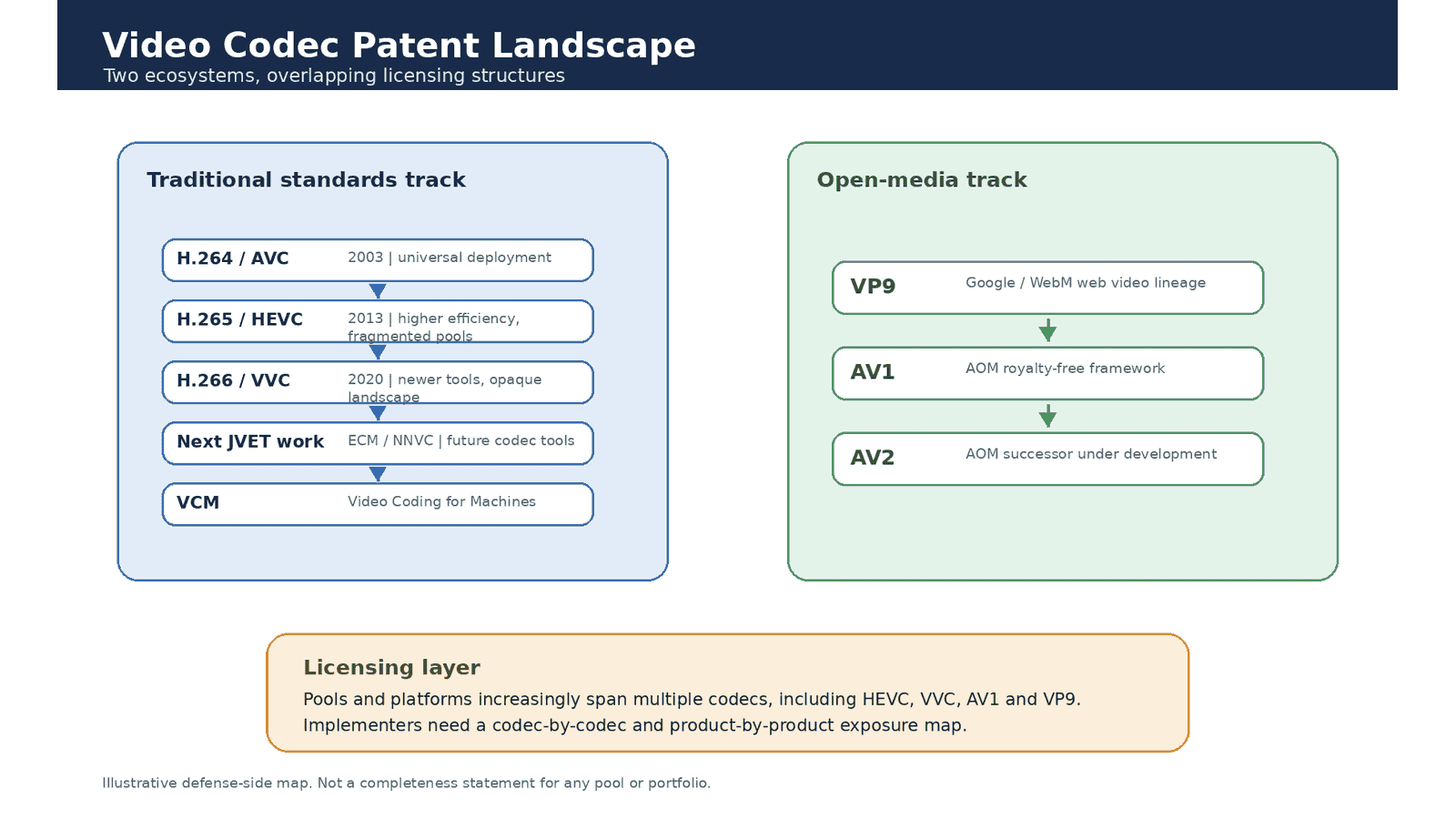
The video codec patent landscape is no longer a simple split between FRAND-licensed standards and royalty-free codecs. AVC, HEVC and VVC sit within ITU/ISO standardization and FRAND-style patent-policy frameworks. VP9, AV1 and AV2 come from the open-media ecosystem and use royalty-free patent commitments. But patent pools, non-member patent holders, bilateral licensors and non-pool assertions increasingly overlap across both ecosystems.
For implementers, the key question is not "which codec do we use?" It is more precise: which codec tools do the products actually implement, which asserted patents are truly essential, which pool or bilateral licenses cover the relevant use case, and which claims can be challenged?
This primer maps the video codec patent landscape from the defense side: the perspective of companies that encode, decode, stream, store or analyze compressed video and need to understand their licensing and litigation exposure.
Why video codec patent risk matters
Video codecs sit at the center of the modern digital economy. AVC (H.264), HEVC (H.265), VVC (H.266), VP9, AV1, AV2 and emerging machine-oriented coding work are relevant to streaming services, smartphones, smart TVs, laptops, cameras, games, video conferencing, cloud platforms, automotive systems, surveillance, industrial vision and AI-based video analytics.
That ubiquity creates patent exposure.
The difficult question for implementers is not simply whether a product uses H.264, HEVC, VVC, VP9, AV1 or another codec. The better question is:
- Which codec profile, level, toolset and optional features are implemented?
- Which patents are actually essential to those features?
- Which patent pools cover the product category, service model, territory and use case?
- Which patent owners remain outside the pool?
- Which asserted patents can be challenged on essentiality, non-use, claim construction, priority or invalidity?
This is the same claim-level discipline behind defensive SEP analysis more generally. The licensor's chart is an argument to be tested, not a conclusion. For a deeper discussion of that workflow, see our practice note on defensive essentiality analysis.
Are video codecs royalty-free, FRAND-licensed or pool-licensed?
The video codec world is shaped by two overlapping licensing ecosystems.
The traditional standards track runs through ITU-T and ISO/IEC. This ecosystem produced the dominant lineage of H.264/AVC, H.265/HEVC and H.266/VVC. Today, the relevant ISO/IEC work sits within ISO/IEC JTC 1/SC 29, including MPEG Video Coding and JVET. MPEG describes JVET as the joint video coding team of ISO/IEC SC 29 WG 5 and ITU-T SG21/WP3, responsible for VVC and continuing video coding work. See the MPEG JVET overview.
Patents declared against these traditional standards are subject to the applicable standards-body patent-policy framework. In practice, that usually means a licensing commitment on FRAND or RAND terms. But FRAND does not answer the core implementer-side questions: whether a patent is actually essential, whether the asserted claim construction is sustainable, whether the requested royalty is proportionate, and whether the patent is relevant to the implementer's actual products.
The second ecosystem is the open-media track. This includes VP9, AV1 and AV2. VP9 was developed by Google and the WebM Project. The WebM Project describes VP9 as its next-generation open video codec, available from June 2013, and Google describes VP9 as supporting web and mobile use cases including adaptive streaming, ultra-HD, 10/12-bit encoding and HDR. See the WebM VP9 summary and Google VP9 developer guidance.
AV1 was developed by the Alliance for Open Media as an open video codec for internet video. The AOMedia Patent License 1.0 grants a no-charge, royalty-free patent license to "Necessary Claims", subject to reciprocity and other license conditions. AOMedia has also described AV2 as the next-generation video coding specification from the Alliance for Open Media. See the AV2 specification site.
That does not mean open-media codecs are patent-risk-free. It means the AOM licensing framework is designed to remove royalty payments for patents covered by that framework. Patent owners outside the AOM commitment can still assert patents or offer pool licenses. Sisvel, for example, operates a video coding licensing platform with VP9 and AV1 programs. See Sisvel's video coding platform.
The result is a hybrid landscape. Traditional standards, royalty-free codec initiatives, patent pools, bilateral licensors and assertion entities now overlap. Implementers should avoid a simple binary view of "FRAND codec" versus "royalty-free codec." Both ecosystems require patent review.
Comparison of Codec generations and implementer exposure
| Technology | Origin or standards context | Licensing posture | Implementer-side risk question |
|---|---|---|---|
| AVC / H.264 | ITU-T and ISO/IEC | Mature pool and bilateral licensing environment | Is the product or service already licensed, and does the use case fall inside the relevant license? |
| HEVC / H.265 | ITU-T and ISO/IEC | FRAND declarations, pools and non-pool exposure | Which pool covers the product, and what remains outside the pool? |
| VVC / H.266 | ITU-T and ISO/IEC JVET | Newer FRAND and pool environment | Which patents are visible, actually essential and relevant to implemented VVC tools? |
| VP9 | Google / WebM Project | Open-media origin, but pool assertions exist | Does the implementation rely on tools covered by non-AOM or non-Google patent owners? |
| AV1 | Alliance for Open Media | Royalty-free AOM patent framework, with non-member assertion risk | Which patents are covered by AOM commitments, and which asserted patents sit outside them? |
| AV2 | Alliance for Open Media | Emerging AOM successor to AV1 | How will future AOM commitments, exclusions and third-party patent positions develop? |
| MPEG-DASH | ISO/IEC adaptive streaming standard, not a codec | Sometimes included in video licensing platforms | Is the service exposed through delivery-standard licensing in addition to codec licensing? |
| VCM | Emerging ISO/IEC Video Coding for Machines activity | Developing standards-related patent ecosystem | Will machine-oriented video analytics create a new SEP exposure layer? |
H.264/AVC remains deeply deployed because of its long product life, hardware support and mature ecosystem. HEVC delivered meaningful compression gains over AVC, but its licensing environment became a warning example for implementers. Instead of one simple licensing path, many companies faced multiple licensing programs and possible bilateral demands.
The HEVC and VVC landscape has consolidated in part. Access Advance states that it acquired Via LA's HEVC/VVC program as of December 15, 2025, and that the program is now VCL Advance. See Access Advance's VCL Advance page. Consolidation can reduce transaction complexity, but it does not eliminate the need to test coverage, product scope, use case, territory and non-pool exposure.
VVC is the successor to HEVC. Fraunhofer HHI describes VVC as ITU-T H.266 | MPEG-I Part 3 and states that it achieves about a 50 percent bit-rate reduction compared with HEVC at the same subjective video quality across a broad range of content and applications. See the Fraunhofer H.266/VVC overview.
From the defense side, the VVC problem is not only technical performance. It is transparency. Third-party analysis has reported that many VVC SEP owners had not provided patent lists to the ITU as of early 2024. See IAM's discussion of the VVC patent landscape transparency problem. That type of analysis should be treated as a landscape indicator, not an essentiality determination. But it illustrates the practical issue: blanket declarations and incomplete patent lists do not tell an implementer which claims actually read on mandatory VVC features.
MPEG-DASH should be kept separate from the codecs themselves. MPEG-DASH is an adaptive streaming standard used to deliver media segments over HTTP. It becomes relevant because some licensing platforms include MPEG-DASH together with codec standards.
VCM, or Video Coding for Machines, is different again. It is directed toward machine consumption of video, such as object detection, segmentation, tracking and automated analysis tasks. ISO lists ISO/IEC 23888-2 as "Artificial intelligence for multimedia - Part 2: Video coding for machines." See the ISO/IEC 23888-2 project page. For automotive systems, smart cities, industrial automation, robotics, retail analytics and surveillance, VCM may become a new standards-related patent ecosystem at the intersection of video coding and AI.
Patent declaration infrastructure: the transparency gap
One of the most important differences between video codecs and cellular standards is declaration infrastructure.
Cellular SEP teams are used to the ETSI IPR database. That database is imperfect, self-declared and does not decide actual essentiality. But it gives implementers a structured starting point for identifying declared patent families, standards and owners.
The video codec world is less transparent.

ITU-T declarations can include blanket statements without specific patent numbers. ISO/IEC declarations are recorded without the standards body determining actual essentiality. Licensing negotiations then happen outside the standards body. As a result, a company may claim to hold essential patents without providing the level of detail an implementer needs for reliable exposure assessment.
Pool patent lists can help. Access Advance, VCL Advance, Sisvel, MPEG LA, Avanci and other licensing platforms may identify licensors and, in some cases, patent lists. But pool lists are not the full landscape. Major patent holders may remain outside pools, join later, license bilaterally or transfer patents to entities that assert them separately. Regardless, an independent analysis is highly advised.
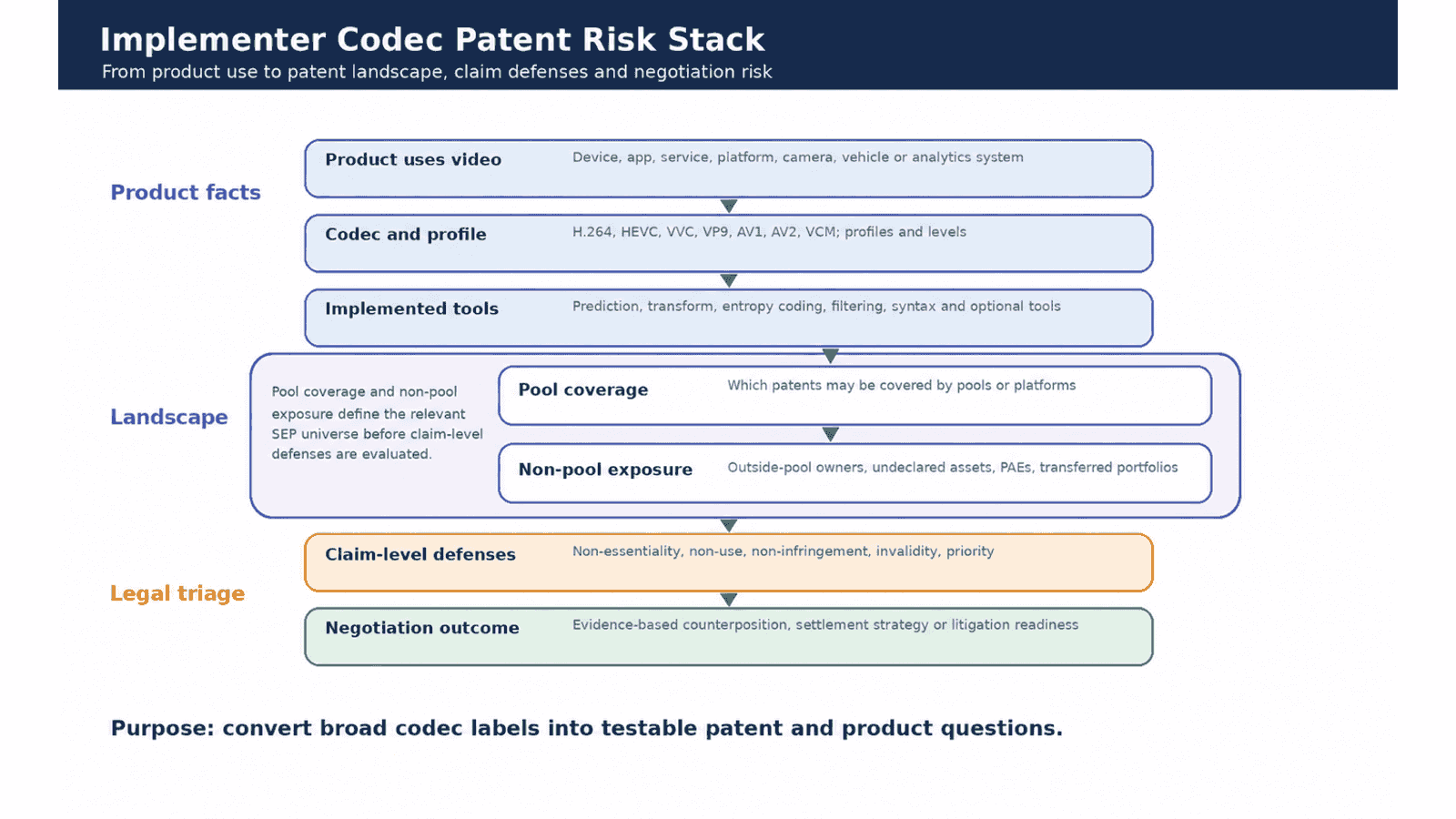
For implementers, this creates an information asymmetry. A licensing demand may arrive with selected claim charts and a commercial offer, but without a neutral map of the patent landscape. The implementer must then determine whether the asserted patents are actually essential, whether they cover mandatory codec features, whether the accused product implements those features, and whether the demanded royalty reflects the actual strength of the portfolio.
Patent pools and licensing structures
The codec licensing environment has become more consolidated in some areas and more complex in others.
Access Advance administers HEVC and VVC licensing programs and operates the Video Distribution Patent Pool. Its VDP scope page describes a license for distinct branded video streaming service providers transmitting content encoded in HEVC, VVC, VP9 or AV1 over the internet. See the Access Advance VDP pool scope.
Avanci Video targets internet video streaming services and describes its platform as covering AV1, H.265/HEVC, H.266/VVC, MPEG-DASH and VP9. That service-level focus matters. A device manufacturer, app provider, cloud platform and streaming service may face different licensing questions even when the same codec appears in the stack.
Sisvel operates VP9 and AV1 licensing programs. Its position is that some patent owners for those codecs sit outside the open-media commitments. Whether any asserted patent is valid, essential and relevant to a specific product remains a separate claim-level question.
Non-pool patent holders remain important. Some companies license bilaterally. Some assert directly. Some monetize through sales or transfers. For example, SIM IP recently acquired Alibaba's video coding patent portfolio covering AV1, AV2, and VCM — illustrating how operating companies whose membership in open-standard consortia constrains direct enforcement may instead monetize through specialized assertion entities. See SIM IP's announcement.
Why independent essentiality analysis is critical
Declaration data, pool participation and claim charts are not enough.
A patent may be declared essential, submitted to a pool or asserted in a licensing demand. None of these facts proves that the patent actually reads on a mandatory feature of the codec standard. Nor does it prove that the implementer's product practices the relevant feature.
Independent essentiality analysis answers the central question: does the asserted claim map to the technical specification in a way that makes infringement unavoidable for a compliant implementation of the relevant product or service?
For implementers, this analysis has three practical functions.
First, it identifies patents that can be challenged or deprioritized. This can reduce licensing pressure.
Second, it creates negotiation leverage. An implementer with its own evidence on essentiality, non-essentiality, non-use and invalidity is in a fundamentally different position from an implementer negotiating only from the patent owner's selected claim charts.
Third, it supports litigation readiness. If a dispute escalates, the same analysis can feed non-essentiality positions, non-use positions, invalidity attacks, claim-construction arguments and proportionality arguments.
Codec analysis is technically demanding. HEVC, VVC, VP9, AV1 and future VCM work involve transform coding, intra and inter prediction, motion compensation, entropy coding, loop filtering, high-level syntax, reference-picture handling, screen-content tools, profiles, levels and optional implementation choices. A good analysis therefore requires both video-compression expertise and patent-litigation judgment.
AI can help at scale. It can search large patent corpora, identify candidate mappings, compare claim language with standards passages and surface early disqualifiers. But expert review remains essential for defensible conclusions, particularly where the analysis must stand up in licensing negotiations or litigation. This is why we offer Evidence-as-a-Service instead of direct access to our agentic-AI platform – so you can have actionable, validated insights on how to negotiate.
For a product-specific example of how a broad declared SEP landscape can be narrowed to the actual implementation, see our note on product-specific SEP landscaping.
Implementer checklist for codec SEP demands
Before taking a codec license or responding to a demand, an implementer should build a product-specific evidence record:
- Identify each codec in the product or service stack.
- Separate codecs from delivery standards such as MPEG-DASH.
- Identify codec profiles, levels, optional tools and hardware or software paths.
- Determine whether the relevant feature is mandatory or optional.
- Map asserted claims to exact standards passages.
- Test whether the product actually implements the mapped tool.
- Review pool coverage by product category, territory, sale model and service model.
- Identify non-pool patent owners and bilateral exposure.
- Check priority, prosecution history, prior art and standardization contributions.
- Prepare a negotiation position that distinguishes strong patents from weak or irrelevant ones.
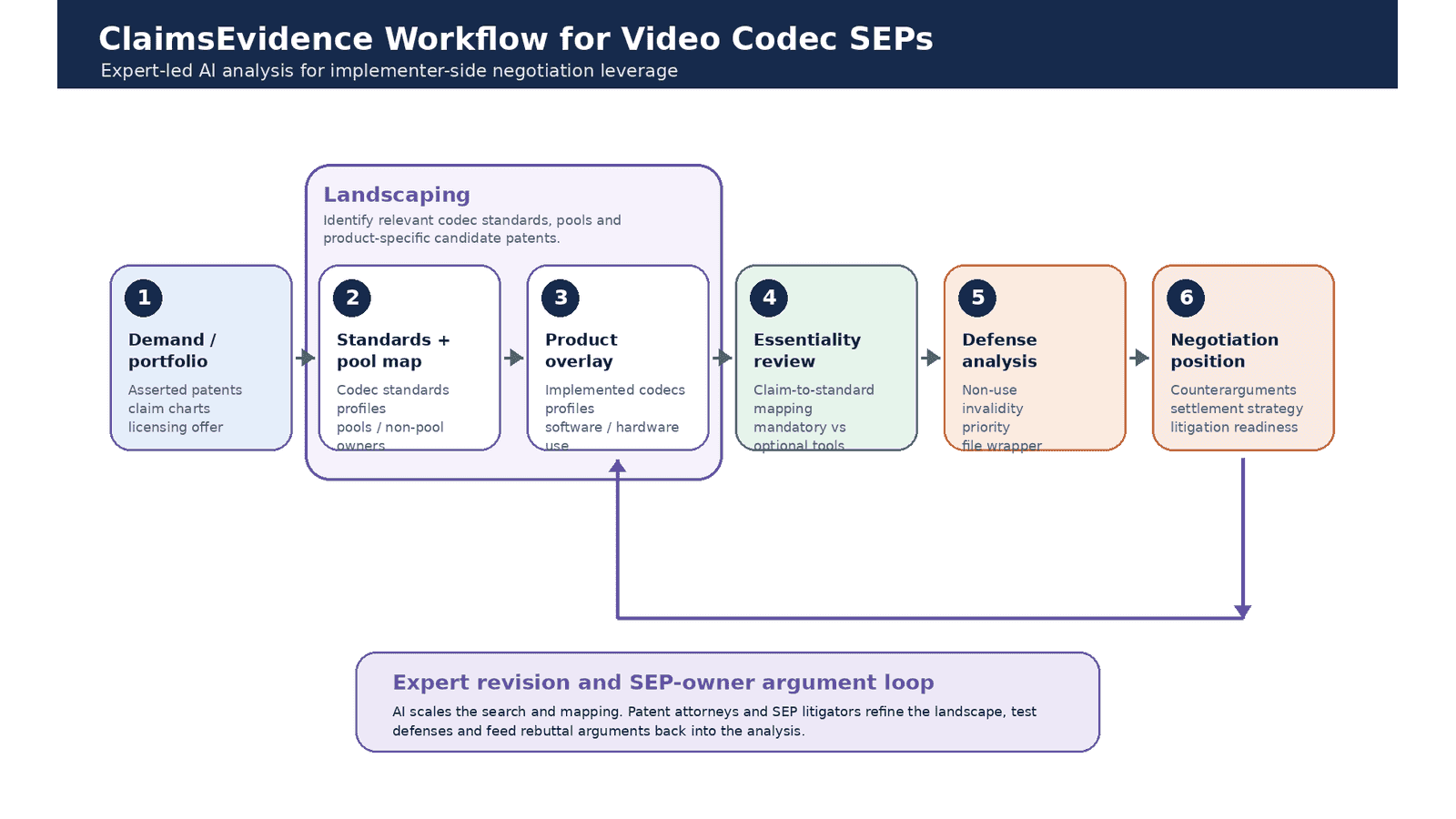
This is the same practical posture we recommend for SEP demands generally: turn the demand letter into an evidence-based negotiation position before commercial pressure hardens into assumed liability. See our practice note on moving from an SEP demand letter to a defensible negotiation position.
What is next for video codec patents?
The video codec patent landscape is becoming more complex, not less.
The successor path beyond VVC is being explored through ongoing technical work, including enhanced compression and neural-network-based approaches. As neural tools enter codec standardization, future patent claims may sit at the intersection of video compression and machine learning.
VCM may create another layer. If machine-oriented video coding becomes important for autonomous systems, industrial vision, smart cities, retail analytics or surveillance, implementers may face a new standards-related patent environment before the market fully understands its exposure.
Patent transactions and assertion models are also evolving. Portfolios can move from operating companies to licensing entities, and patents developed in one technical context can later be asserted in another. That is particularly important in codecs because the same underlying coding tools may appear across standards, profiles and implementations.
For implementers, the lesson is clear: codec patent risk should not be evaluated only after a licensing demand arrives. It should be mapped proactively, especially where a company's products encode, decode, stream, store or analyze video at scale.
FAQ
What is the video codec patent landscape?
It is the overlapping set of declared SEPs, patent pools, bilateral licensors, royalty-free patent commitments and non-pool patent owners associated with video compression technologies such as AVC, HEVC, VVC, VP9, AV1 and AV2.
Is AV1 really royalty-free?
AV1 was developed under the AOMedia royalty-free patent framework, and the AOMedia Patent License grants royalty-free rights to covered Necessary Claims subject to conditions. But that does not eliminate all patent risk. Patent owners outside the AOM commitment may still assert patents or offer licenses.
Why did HEVC licensing become fragmented?
HEVC had multiple licensing programs and possible bilateral exposure rather than one simple licensing path. That fragmentation contributed to implementer interest in royalty-free alternatives such as AV1 and remains an important lesson for VVC and future codecs.
Is MPEG-DASH a video codec?
No. MPEG-DASH is an adaptive streaming standard for delivering media over HTTP. It matters in codec licensing because some video licensing platforms include MPEG-DASH alongside codec standards.
What should implementers check before responding to a codec SEP demand?
Implementers should check the actual codec implementation, profiles, optional tools, pool coverage, non-pool exposure, claim-to-standard mappings, product use and claim-level defenses. The fact that a product uses video is only the first layer of the analysis.
The ClaimsEvidence approach
ClaimsEvidence helps implementers turn codec SEP exposure into an evidence-based negotiation position.
We combine our agentic-AI powered patent and standards analysis platform with expert review by patent attorneys and SEP litigators. The goal is not merely to produce a list of patents. The goal is to determine which patents are likely to be technically and legally important, which patents can be challenged, and which parts of the asserted portfolio actually create risk for the implementer's products.
For video codec matters, this can include:
- mapping asserted patents to codec standards and profiles,
- identifying whether the alleged standard feature is mandatory or optional,
- testing whether the product actually implements the relevant codec tools,
- comparing patent claims against standards passages,
- reviewing pool participation and declaration data,
- identifying non-pool exposure,
- analyzing prior art and earlier standardization material,
- preparing non-essentiality, non-use and invalidity positions,
- supporting licensing negotiation and litigation readiness.
In codec licensing, as in cellular SEP licensing, implementers should not have to negotiate blind. The right starting point is evidence: the patent claims, the specification, the standard, the product implementation and the actual strength of the asserted portfolio.
Get our practice notes and deep-dive reports first
We publish deep technical analyses on SEP essentiality, FRAND evidence, and patent-licensing risk — with purpose. Subscribe to get each one when it lands.
No spam. Unsubscribe any time.
About the author

Christoph Hewel
ClaimsEvidence Co-Founder & CPO · Patent Attorney & UPC Representative
Christoph Hewel is a patent attorney and UPC representative with extensive experience in SEP litigation. He is Co-Founder / CPO of ClaimsEvidence and has represented clients in major patent cases, including Huawei v. Unwired Planet, Microsoft v. SIA, and Wiko / Google / Asus / HTC v. Philips, among others.
View LinkedIn profile