How Many SEPs Are There in 4G and 5G, Really?
For the cellular standards of 4G and 5G, the public starting point is ETSI's IPR declaration database, which records roughly 123,500 distinct patent families self-declared as potentially essential to 4G/5G — a number that most analytics inflate and few deflate honestly. This number is derived after a careful curation and analysis of the ETSI IPR database.
As an implementer of standard technologies (4G/5G), you need clear evidence to assess SEP exposure and manage risk and liabilities. SEP analytics reports are typically written with the patent-owner lens. This analysis takes the implementer's point of view, to help you understand what the ETSI IPR database actually shows about your exposure. The underlying data is the ETSI ISLD IPR declaration database — the public record of every patent an owner has declared as potentially essential to a 3GPP standard. Our analysis here is clipped to declarations up until 2025-12-31 (and exported as of May 2026).
What implementers need to know for SEP licensing
If you build a product that speaks LTE or 5G NR, you've encountered some large numbers. Hundreds of thousands of SEP declarations. Tens of thousands of patent families. Most published SEP analytics are built for patent owners — ranking portfolios, benchmarking declaration counts, measuring who leads the 5G race.
This post takes the implementer's perspective. We start from the same public ETSI data that underpins most SEP analytics, and we deflate it — step by step, transparently — until we reach the number a product team should actually plan around. Then we lay out what that number means for managing your licensing exposure over time.
We deliberately name no companies and publish no holder rankings. As an implementer, you don't care that some particular firm declared 11,000 families. You care about three things:
- How large is the encumbered surface (risk zone) I'm shipping into?
- How many counterparties do I need to negotiate licenses with for my unique exposure?
- Is that surface fixed at launch, or does it keep growing?
1. From declarations to inventions: counting what matters
ETSI's database is the most comprehensive public record of cellular SEP declarations in existence. For 4G and 5G alone, after applying audit-hardened counting rules for deduplication and deflation, we reach the following numbers as of the 2025-12-31 cutoff:
- 461,565 declaration rows — each row is one patent paired with one spec-version of 4G/5G. This is the number that often appears in headlines, but it counts paperwork, not inventions.
- 137,958 patent publication numbers — each is one patent document in one jurisdiction. A single invention filed in the US, EP, CN, KR, and via PCT appears five times here.
- 123,529 distinct patent families — each family represents one invention, regardless of how many specs it was declared against or how many countries it was filed in.
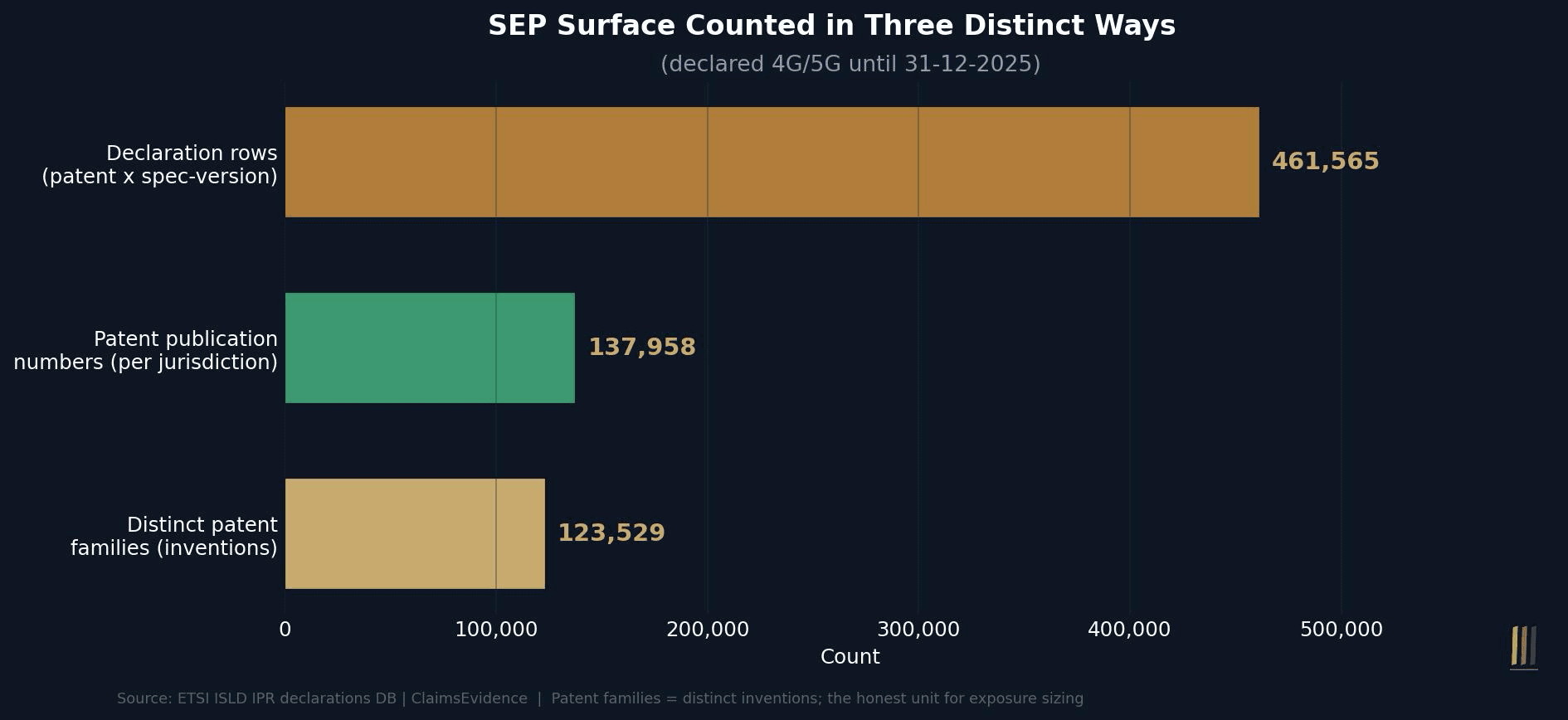
The right unit of measurement for exposure sizing is patent families. Everything above that double-counts — either across the spec axis (declaration rows) or the geography axis (publication numbers). A count of 461,565 isn't wrong, but it describes the volume of declarations, not the volume of distinct inventions. Similarly, the 138K publications number sounds more precise than it actually is, because it conflates the filing geography with the actual inventive scope.
So the working number is ~123,500 declared 4G/5G families. But we're not done deflating.
The next question is where those declared families concentrate. Our protocol-layer concentration map of 4G/5G SEP risk shows why PHY and RRC create a much denser exposure zone than core-network or application-layer specifications.
2. Declared ≠ essential — and the gap is large
This is the single most important point in this analysis:
ETSI does not test essentiality. A declaration means a holder believes a patent may be essential. No independent body has checked.
ETSI's IPR Policy requires holders to declare patents they consider potentially essential to a standard. There is no examination, challenge, or filter at the point of declaration. The incentive structure is asymmetric: under-declaring carries legal risk, while over-declaring carries very little. In practice, this leads to broad, defensive declaration behavior — and in some cases, over-declaration may be a deliberate strategy to improve inputs to FRAND licensing economic formulas.
Courts and experts have produced widely varying essentiality rates — estimates run from ~40% down to ~16.6%, with some anecdotal evidence even lower. For 3G, a 2005 study by Goodman and Myers found ~21% of self-declared 3G patents to be essential. In TCL v. Ericsson, the US court worked from a ~40% essentiality rate across self-declared 2G/3G/LTE SEPs. And in the UK High Court judgment Unwired Planet v. Huawei [2017] EWHC 711 (Pat), the much-cited 16.6% figure from the MNP study anchored the Top-Down approach for LTE.
Taking a rough ~20% of ~123,500 ≈ ~24,700 families is a defensible order-of-magnitude estimate for what a product team should treat as the plausibly essential 4G/5G surface.
That is roughly 5% of the 461,565 declaration rows in the uncurated ETSI IPR database.
BUT. Without a detailed analysis we can't tell exactly which "20%" and how this number varies from holder to holder, and feature to feature. Not every 5G specification is equally patented, similar to how not every portfolio is equally commercially strong.
Essentiality analysis is a per-patent, per-claim, per-spec-clause technical determination. It requires mapping individual patent claims against specific standard sections and paragraphs — exactly the kind of evidence work that ClaimsEvidence was built to deliver as a service. Our approach combines experienced patent litigators with purpose-built agentic AI to produce claim-level essentiality analysis at a scale, quality, and cost that traditional approaches can't match. The ~24,700 figure is a rough order-of-magnitude estimate, not a conclusion. Any precise "essential SEP count" that hasn't been grounded in per-claim analysis is a guess, not evidence.
3. How licensing looks from the implementer's perspective
A six-figure family count sounds like an unbounded liability. In practice, it isn't — because declared SEP ownership is concentrated and not all SEPs are liabilities to you. This is the one place where the large numbers actually work in an implementer's favor.
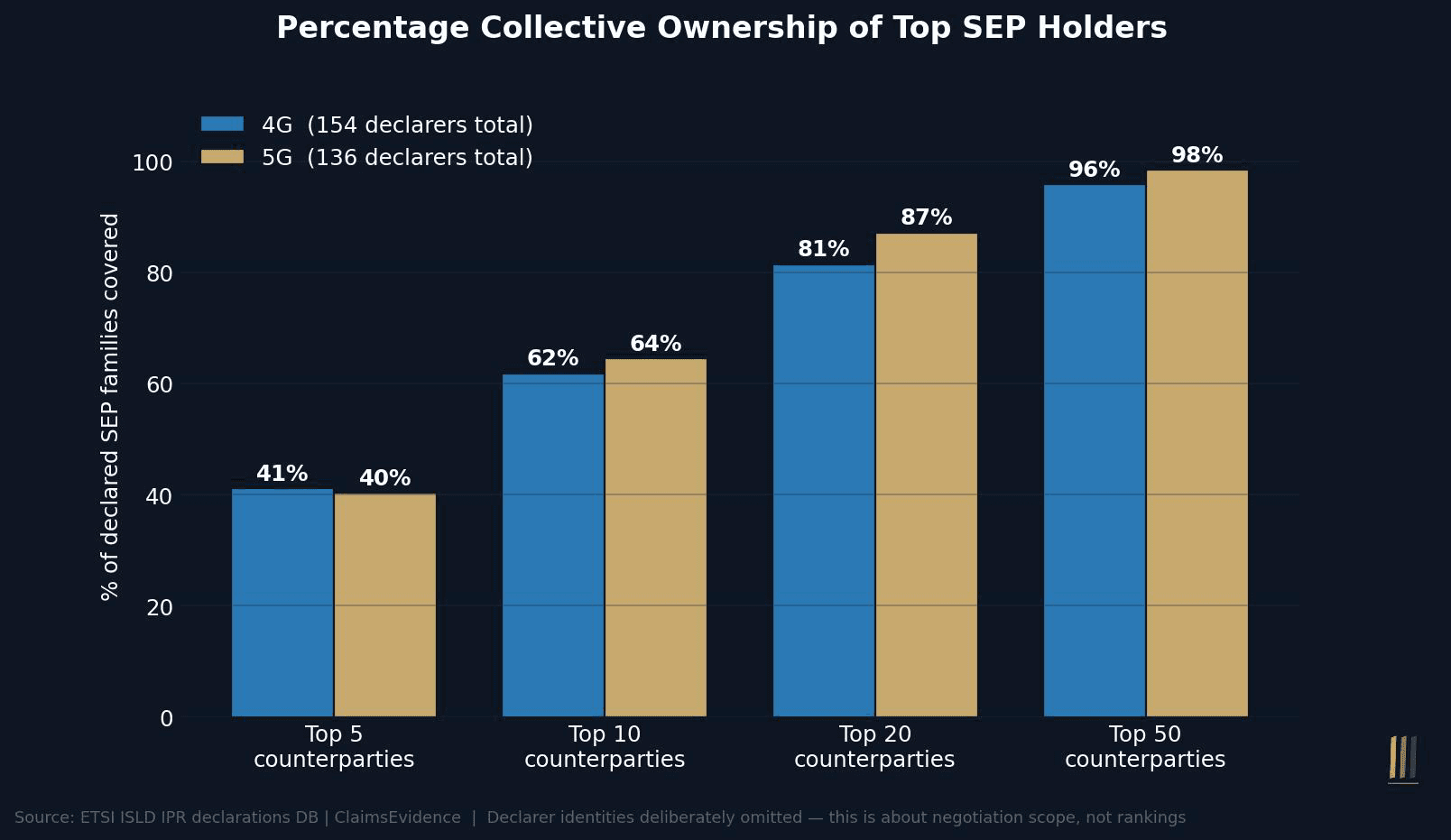
We've removed every company name from the chart above. The point for now is not who owns the standard — it's how many counterparties you need to engage to cover most of your exposure. After deduplication we counted ~136 distinct declarers in 5G and ~154 in 4G. But the long tail past the top ~20 collectively holds only about a tenth of declared families. Furthermore, not every 4G SEP or 5G SEP is relevant to a product team, which further reduces your unique exposure surface.
One practical way to narrow that exposure is to use LTE categories as a first gate for product-specific SEP triage.
- The top 5 declarers clear roughly 40% of the declared 4G/5G family surface.
- The top 10 clear roughly 62%.
- The top 20 clear roughly 85–88% — and 5G appears slightly more concentrated than 4G.
Your specific implementation determines your unique "danger zones" in the 4G and 5G landscapes. Knowing which SEPs are relevant to your product line is essential to any licensing strategy that has a clear plan of defense and allows you to negotiate from a position of knowledge.
4. The surface keeps growing after you launch
A patent does not have to be declared when it is filed, when it is granted, or when the standard freezes. This is the reason a SEP assessment can't be treated as a one-time exercise.
Holders declare on their own schedule — and in this dataset, the mean lag between a patent's filing date and its ETSI declaration is ~3.9 years, with a long tail extending past 10–15 years as portfolios are acquired, pools form, and older patents are re-flagged against new spec releases.
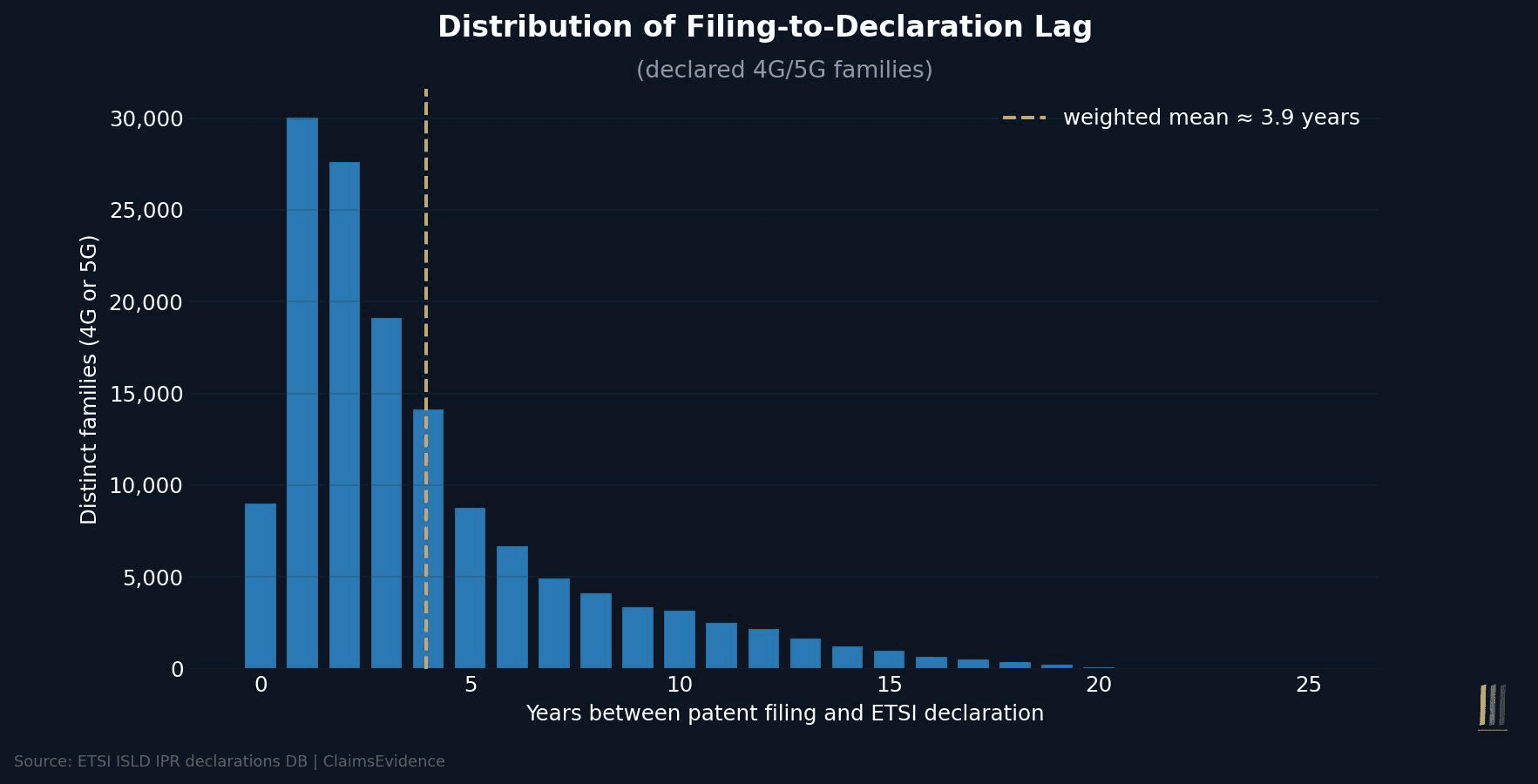
The most common lag is just one year, but the distribution is long-tailed: roughly a quarter of families are declared five or more years after the underlying patent was filed, and a meaningful tail stretches past two decades.
The practical consequences for an implementer:
- An exposure assessment is a floor, not a ceiling. Families declared against the specs you ship will keep accumulating for years after launch. The most recent vintage years in any SEP dataset are structurally undercounted — patents filed in 2023–2024 are still being declared.
- "It wasn't declared when we shipped" may not hold as defense. The holders' have the responsibility to declare SEPs as fast as possible, but they certainly act based on their own patent strategy, not your product roadmap.
- SEP monitoring needs to be continuous. A one-time snapshot decays. This is why we build agentic monitoring into our platform rather than delivering static reports — the evidence layer has to stay current or it stops being useful.
If you want to continuously monitor the exposure risk your products face against the SEP landscape, ClaimsEvidence can support you — get in touch to discuss your unique situation.
5. FAQ: What an implementer should take away
| Question | Answer |
|---|---|
| How many 4G/5G potential SEPs are there? | ~123,500 declared families. Not 461,565 — that counts declarations, not inventions. |
| How many SEPs actually matter? | On the order of ~24,700 plausibly essential (~20%, rough midpoint of the 10–30% estimate range the literature supports – not a conclusion). Which specific families? That requires per-claim analysis. |
| How many parties must I deal with? | There's a large ~80-90% concentration among the top 20 holders, but your licensing situation is highly specific and implementation dependent. |
| Is my SEP exposure final at launch? | No. With a ~3.9-year average declaration lag, the surface keeps growing. Assessment should be a continuous process. |
| How should I evaluate any "essential SEP count"? | Look for per-claim essentiality and invalidity assessment work behind the number. Without it, you're looking at an estimate applied to an already-inflated count. |
The headline numbers you come across may be real — but they measure declarations, not inventions, and certainly not essential inventions. The figure a product team should carry into a budget conversation is roughly an order of magnitude smaller than the raw declaration count.
Knowing the size of the surface is the first step. The next step is understanding where in the standard the density actually sits — because it is not spread evenly. In the (to be published) companion piece, Where 4G/5G SEP Licensing Risk Concentrates, we map the encumbrance by protocol layer, so you can see whether your specific product sits in the dense zone or outside it.
About ClaimsEvidence
ClaimsEvidence is the evidence layer for FRAND licensing. We combine experienced patent litigators with purpose-built agentic AI to deliver claim-level SEP analysis — essentiality assessments, invalidity analysis, and defense strategies — at a scale and cost that makes per-patent evidence practical, not aspirational. If you're sizing your SEP exposure, want to continuously monitor it, or prepare for a licensing negotiation, contact ClaimsEvidence.
Get our practice notes and deep-dive reports first
We publish deep technical analyses on SEP essentiality, FRAND evidence, and patent-licensing risk — with purpose. Subscribe to get each one when it lands.
No spam. Unsubscribe any time.
About the author

Konstantinos Poulinakis
ClaimsEvidence Co-Founder & CEO · AI expert
Konstantinos Poulinakis is the Co-Founder & CEO of ClaimsEvidence. He has 7+ years of experience architecting and leading AI solutions, for the highly-regulated, high-stakes industries of legal and finance. Former Senior AI engineer at Deutsche Bank and Aleph Alpha, the German frontier AI lab.
View LinkedIn profile