LTE Cats in SEP Analysis: A First Gate for Patent Infringement Evaluation

LTE categories help implementers and owners of Standard Essential Patents (SEP) classify the accused product before reviewing the asserted patents. It's a useful first gate for deciding which patent clusters deserve deeper attention. Category information is not a substitute for claim analysis, or implementation review, but acts as an early filter during product-specific infringement analysis. A lower or mid-tier LTE category may suggest a product is closer to baseline LTE connectivity, while higher categories may indicate a greater likelihood of LTE-Advanced or high-throughput feature support.
When an implementer receives a licensing demand for LTE patents, one of the first practical questions is surprisingly simple:
What kind of LTE device are we actually looking at?
That question is essential because "LTE" is not a single implementation profile. A payment terminal, an industrial router, a telematics unit, a wearable, a mobile hotspot, and a flagship smartphone may all be described as 4G products. Yet they can sit in very different parts of the LTE standards landscape.
One of the fastest ways to structure that difference is to look at LTE UE categories, commonly referred to as LTE Cats.
Category information is not a full infringement analysis. It does not decide whether a patent is essential or infringed. But it is often a useful first classification layer. It helps distinguish products that are closer to baseline LTE connectivity from products that are more likely to rely on LTE-Advanced or high-throughput enhancement paths. When an SEP demand letter arrives, LTE category information can help convert a broad licensing assertion into a more defensible negotiation position.
For product-specific SEP review, that distinction can create immediate value.
What are LTE UE categories
In 3GPP's LTE framework, UE categories are standardized capability indicators for user equipment. The LTE capability specification TS 36.306 (v18.3.0 pdf) defines the field ue-Category as a combined uplink and downlink capability, and also defines later fields such as ue-CategoryDL and ue-CategoryUL for separate downlink and uplink capabilities. The specification links these categories to physical-layer capability parameters.
In practical terms, an LTE Cat is a shorthand for a defined capability envelope. It can indicate, for example, how much data a device can handle, what kind of radio capability it signals, and where it may sit in the broader LTE feature landscape.
That said, category information should not be misunderstood. A Cat value does not describe every optional feature, every band combination, every software configuration, every network deployment scenario, or every implementation detail. It is a starting point, not the end of the analysis.
For SEP landscaping, that starting point is already useful. Figure 1 illustrates the basic idea.
How LTE categories help in SEP evaluation
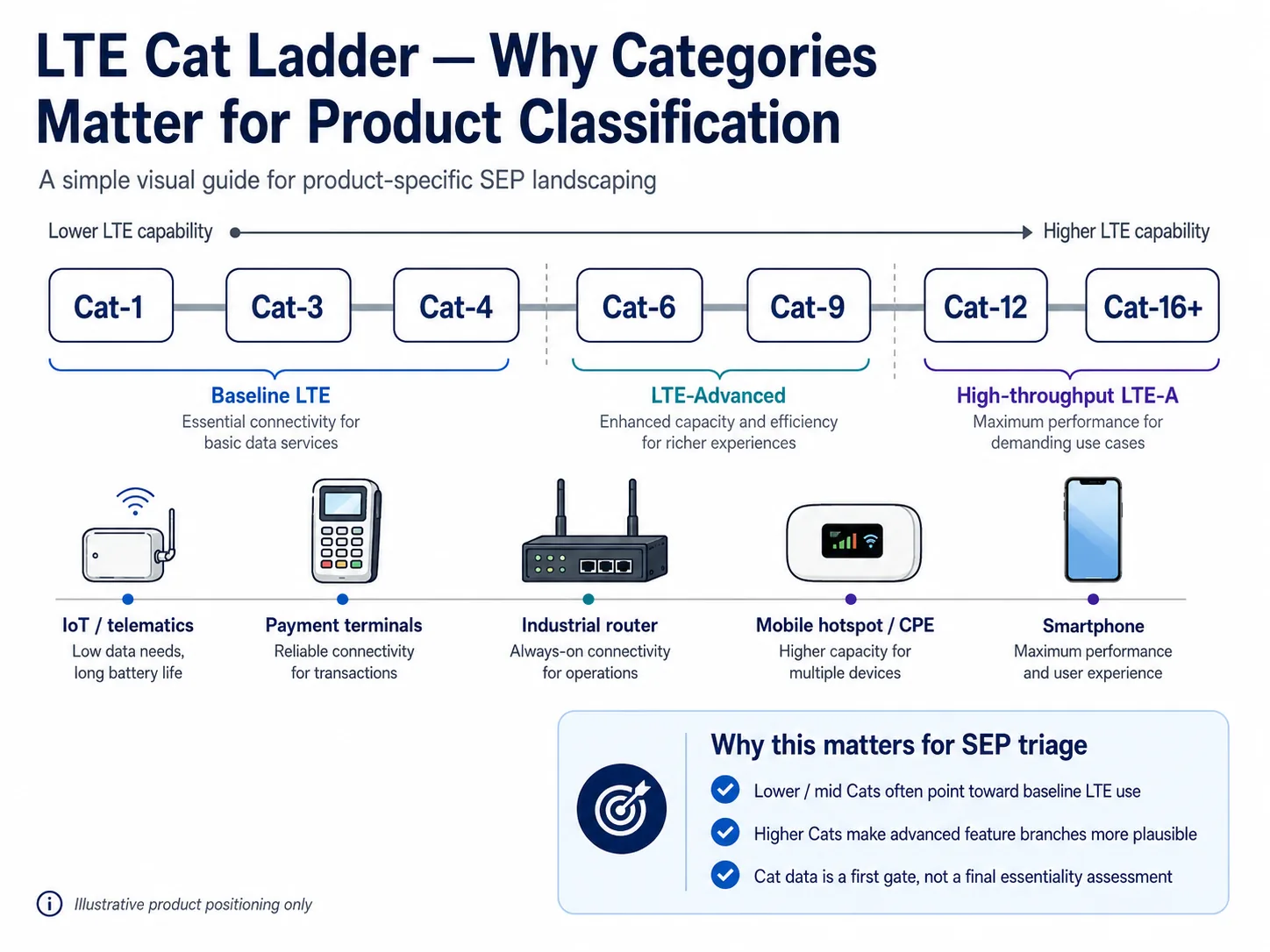
Lower and mid-range LTE categories are often associated with products that need reliable cellular data connectivity without maximum throughput. Typical examples include IoT devices, payment terminals, telematics units, and industrial products.
Higher LTE categories are more naturally associated with devices that require greater capacity, higher throughput, and richer radio capabilities. Typical examples include mobile hotspots, customer-premises equipment, and smartphones.
This does not mean that every Cat-1 or Cat-4 product is legally irrelevant for every advanced LTE patent. It also does not mean that every Cat-12 or Cat-16 product automatically implements every advanced feature. But the category ladder gives a first indication of where the product is likely positioned.
For an early SEP triage, that is often enough to ask the right next question:
Does the asserted patent sit close to the product's likely capability profile, or does it rely on a feature area that is remote from that profile?
Why category information helps in SEP evaluation
The legal question in an SEP dispute is not whether a patent can be linked to LTE at a broad level. The more precise question is whether the patent maps to a feature path that is relevant to the accused product's actual implementation.
Category information helps because it narrows the technical starting point. Public 4G and 5G SEP declaration data can define the outer risk surface, but it does not answer which patents are relevant to a specific LTE product.
A lower or mid-tier LTE product profile may support the view that the product is mainly located in baseline LTE territory. A patent that depends on advanced throughput enhancement, carrier aggregation, or a later LTE-Advanced feature may therefore require closer scrutiny before it is treated as relevant for that product.
Carrier aggregation is a good example. 3GPP describes carrier aggregation as an LTE-Advanced technique used to increase bandwidth and bitrate, while maintaining backward compatibility with Rel-8 and Rel-9 UEs. It is therefore part of a later enhancement logic rather than the simplest baseline LTE connectivity profile.
That does not make carrier-aggregation patents irrelevant in every case. It means they should not be treated as automatically relevant merely because the product uses LTE. For the broader layer-level view of that outer surface, see the PHY/RRC protocol-layer declaration density map.
This distinction is particularly important for IoT and vertical products. A product may use LTE daily for essential business operations, while still operating in a relatively modest capability profile. A payment terminal, for example, may need stable and secure transaction connectivity, not smartphone-level throughput optimization.
LTE Cats vs 5G RedCap
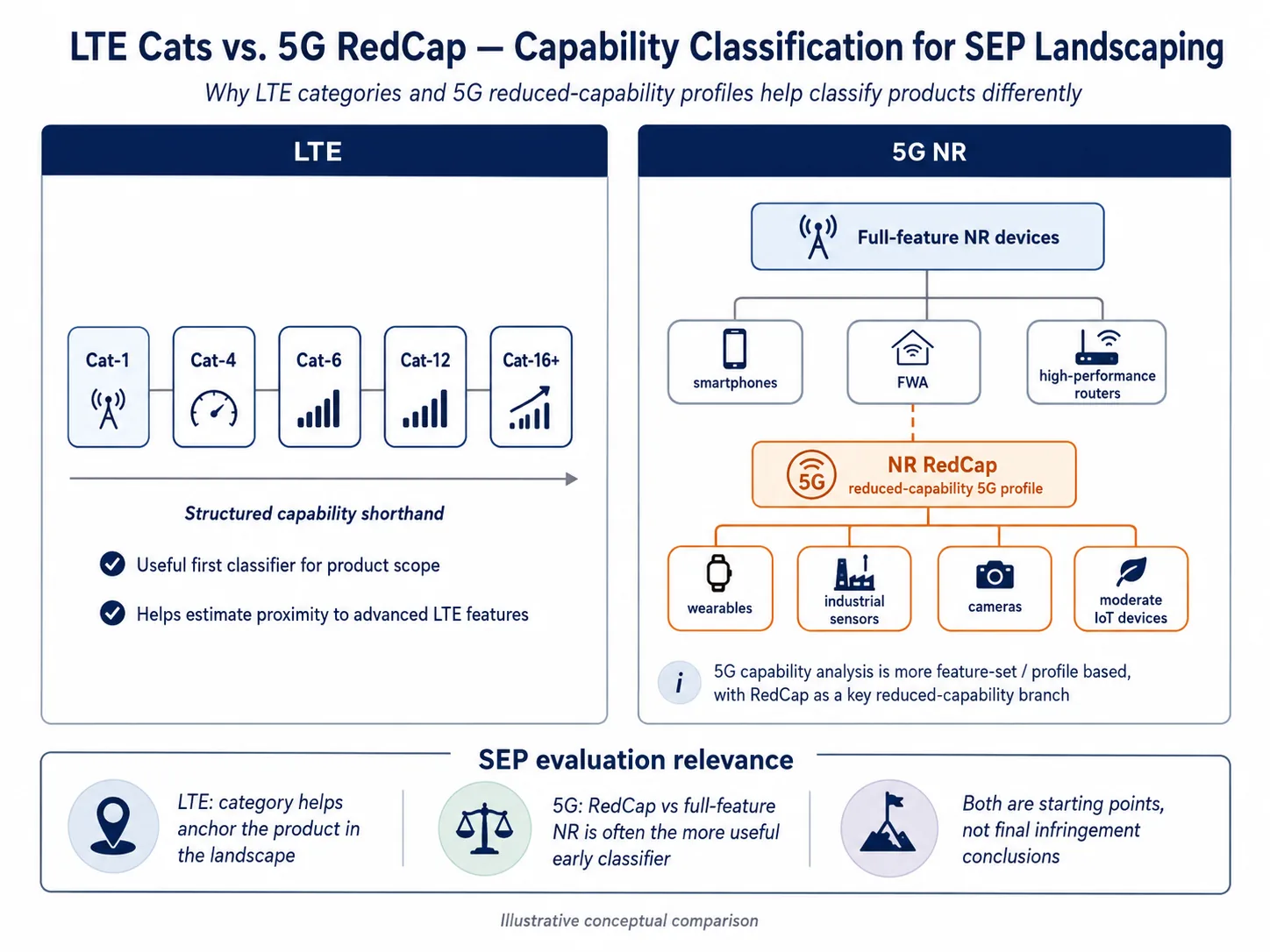
The category discussion becomes more nuanced when moving from LTE to 5G NR.
LTE has a relatively familiar Cat-based capability shorthand. 5G NR does not work in the same simple way. In NR, UE capability analysis is more granular and feature-set driven. A 3GPP RAN document states that, in NR, a UE is characterized by a set of capabilities and that UE categories are not used to differentiate between UEs.
For 5G product landscaping, a more useful reduced-capability reference point is often NR RedCap, short for Reduced Capability. RedCap was introduced in 3GPP Release 17 to support reduced-complexity 5G devices and use cases that do not need full-feature NR performance. Industry summaries describe RedCap as balancing 5G access with reduced capabilities, lower complexity, lower power, and lower cost.
The practical takeaway is:
- LTE: Cat information is often a useful first classifier.
- 5G NR: RedCap versus full-feature NR may be a more useful early distinction.
For SEP evaluation, the underlying question remains the same:
What capability profile does the product really have, and which patent clusters does that make plausible?
How category analysis fits into SEP triage
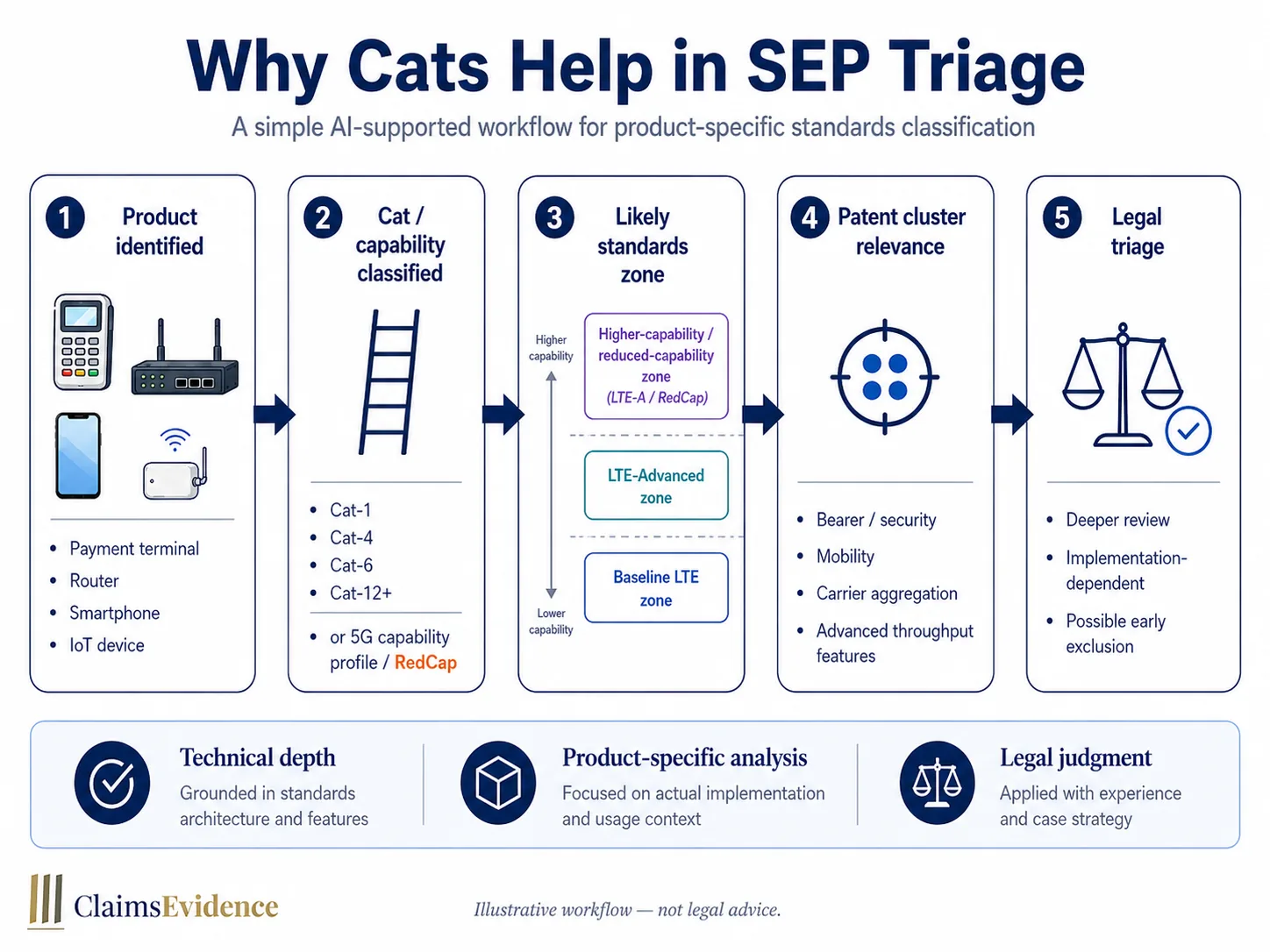
Figure 3 shows how category analysis fits into an AI-supported SEP triage workflow. The process starts with the product. The product is then classified by LTE category or, in 5G, by a capability profile such as RedCap or full-feature NR. That classification helps position the product in the likely standards zone. From there, asserted patent clusters can be reviewed against the product's realistic implementation profile.
The outcome is not a final infringement opinion. The outcome is a legal and technical triage.
Some patents will remain close enough to the product profile to justify deeper review. Others may depend on optional or advanced feature branches. Some may become early candidates for non-use or product-specific non-essentiality arguments.
This is where AI-supported analysis becomes useful, but only when combined with legal judgment. The AI can help structure the standards space, identify feature clusters, and connect patents to technical areas. Patent attorneys and SEP litigators then test those results against claim scope, implementation evidence, optionality, and the likely negotiation or litigation posture.
LTE category analysis is one input into a broader product-specific SEP landscaping workflow, where asserted patents are mapped against the accused product's actual implementation scope.
Patent overlay example: baseline LTE versus advanced features
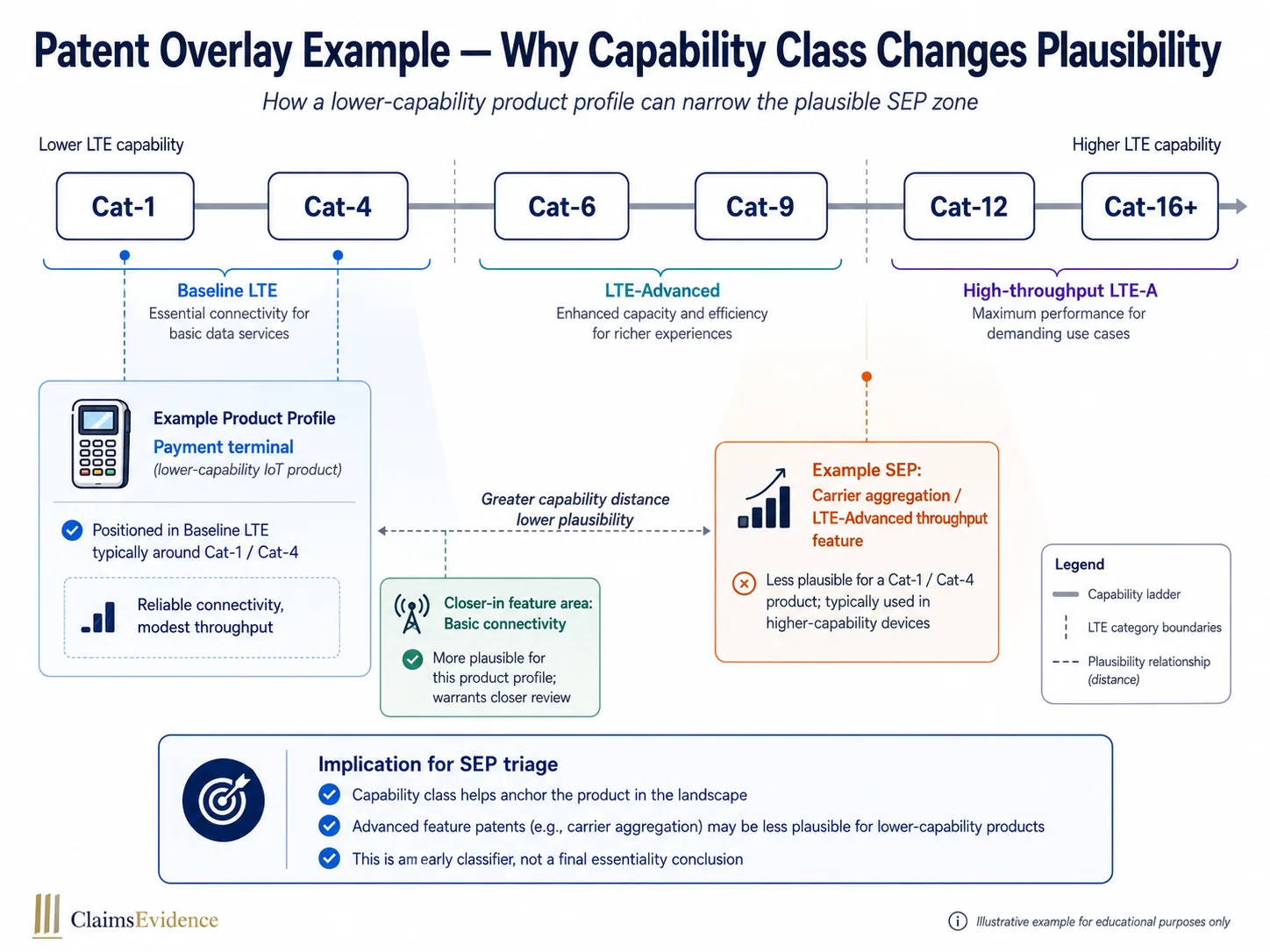
Figure 4 shows the core triage effect in simplified form. A lower-capability product profile, such as a Cat-1 or Cat-4 payment-terminal profile, is typically anchored closer to baseline LTE. A patent directed to basic LTE connectivity, bearer handling, or ordinary control-plane operation may therefore sit relatively close to the product's likely implementation zone.
By contrast, a patent directed to carrier aggregation or another LTE-Advanced throughput feature may sit further away. That distance does not prove non-infringement. But it changes the plausibility assessment.
The legal significance is clear: the patent owner should not be allowed to rely on the general statement "the product uses LTE" if the asserted claim theory depends on a feature that is remote from the product's actual capability profile.
That is the kind of distinction that can support early, evidence-based SEP defense.
Why LTE Cats are useful but not enough
LTE categories should be used carefully. They are useful because they help position the product in the standards landscape. They are limited because they do not prove exactly what the product implements. This is the work of a claim-by-claim analysis. After category-based triage, the analysis still needs claim-level essentiality analysis against the asserted patent claims, standard text, and implementation evidence.
A complete product-specific SEP analysis may still require:
- modem identification,
- UE capability information,
- chipset or module documentation,
- operator certification material,
- product configuration evidence,
- standard-feature mapping,
- and claim-level legal analysis.
That is why ClaimsEvidence treats category analysis as a first gate, not a final conclusion. The right workflow is not: Cat identified → patent excluded.
The right workflow is: Cat identified → product positioned → patent cluster assessed → claim and implementation evidence reviewed → legal triage outcome.
This disciplined approach avoids both extremes. It avoids overreacting to broad SEP declarations, and it avoids dismissing patents too quickly without checking the technical and legal evidence.
Why IoT implementers should classify capability profiles early
IoT implementers are often exposed to SEP demands that use broad terminology. The products are described as "LTE devices" or "5G devices," and that broad label can create pressure.
But IoT products are rarely generic mobile handsets. They often use cellular standards in narrow, purpose-specific ways.
A payment terminal may need secure and reliable transaction connectivity. A smart meter may need low-power periodic reporting. A router may need always-on connectivity. A vehicle device may require mobility and network reliability. A camera or industrial sensor may have its own bandwidth and latency profile.
Each product category has a different position in the standards landscape.
That is why category and capability classification are useful in SEP evaluation. They help move the discussion away from abstract standard membership and toward the real product implementation.
For implementers, that can lead to:
- better portfolio prioritization,
- faster identification of weak assertions,
- clearer technical instructions to internal teams,
- more focused claim-chart review,
- stronger non-use and non-essentiality arguments,
- and better preparation for FRAND negotiations.
The ClaimsEvidence approach to product-specific SEP analysis
At ClaimsEvidence, we use our B2B AI-platform designed for SEP (pre) litigation, to build structured technology landscapes. But we do not deliver raw AI output as the final product. Our in-house SEP litigators and patent attorneys review the analysis through the lens of:
- claim construction,
- essentiality,
- optionality,
- implementation dependency,
- evidentiary burden,
- FRAND negotiation strategy,
- and litigation readiness.
Category information is one input into that process. It helps anchor the product in the relevant part of the standard. It helps identify which patent clusters deserve priority. It also helps detect patents that may be declared or alleged to be essential, but are weak against the implementer's actual product profile.
In complex standards such as LTE and 5G NR, that product-specific view is often decisive. The implementer should not have to negotiate from a vague statement that its products use the standard. It should be able to respond from a precise position based on the patents, the standard, and the real product architecture. The same defense-side discipline applies beyond cellular standards; ClaimsEvidence also uses defense-side SEP analysis for complex codec patent landscapes.
FAQ: LTE categories in SEP infringement evaluation
| Question | Answer |
|---|---|
| Do LTE categories prove whether a patent is infringed? | No. LTE categories do not prove infringement, essentiality, or non-use. They help classify the product's likely capability profile so the filtered patent clusters can be reviewed against the product's actual implementation evidence claim by claim. |
| Why are LTE categories useful for IoT implementers? | IoT products often use LTE in narrow, purpose-specific ways. A payment terminal, smart meter, telematics unit, or industrial sensor may need reliable cellular connectivity without implementing advanced smartphone-level throughput features. LTE category analysis helps separate broad LTE labeling from product-specific technical reality. |
| Are carrier-aggregation patents automatically relevant to every LTE product? | No. Carrier aggregation is associated with LTE-Advanced enhancement logic. A carrier-aggregation patent may still be relevant in some cases, but it should not be treated as automatically relevant merely because the accused product supports LTE. |
| How does this change for 5G NR? | 5G NR does not use LTE-style categories in the same simple way. For 5G product landscaping, capability analysis is more granular. RedCap, or Reduced Capability, can be a useful early reference point for distinguishing reduced-complexity 5G devices from full-feature NR devices. |
Conclusion: from broad LTE assertions to product-specific evidence
LTE categories help answer an important first question in SEP evaluation:
What kind of LTE product is this?
That question helps determine whether the product is closer to baseline LTE connectivity, LTE-Advanced feature areas, or high-throughput enhancement paths. It also helps identify which asserted patents require deeper review and which may be candidates for early product-specific challenge.
For 5G, the same logic applies, but the classification method changes. NR does not use LTE-style categories in the same simple way. Reduced-capability concepts such as RedCap can provide a useful early reference point for product landscaping.
The result is a better SEP triage process. Category and capability analysis help turn a broad licensing assertion into a more precise legal and technical assessment.
At ClaimsEvidence, we combine that AI-supported capability analysis with in-house SEP litigation and patent-attorney expertise. The goal is not to classify products for its own sake. The goal is to build a defensible negotiation position grounded in the standard, the asserted claims, and the implementer's actual product scope. If you are sizing or defending your LTE/5G SEP exposure, get in touch to discuss your product-specific situation.
Get our practice notes and deep-dive reports first
We publish deep technical analyses on SEP essentiality, FRAND evidence, and patent-licensing risk — with purpose. Subscribe to get each one when it lands.
No spam. Unsubscribe any time.
About the author

Christoph Hewel
ClaimsEvidence Co-Founder & CPO · Patent Attorney & UPC Representative
Christoph Hewel is a patent attorney and UPC representative with extensive experience in SEP litigation. He is Co-Founder / CPO of ClaimsEvidence and has represented clients in major patent cases, including Huawei v. Unwired Planet, Microsoft v. SIA, and Wiko / Google / Asus / HTC v. Philips, among others.
View LinkedIn profile